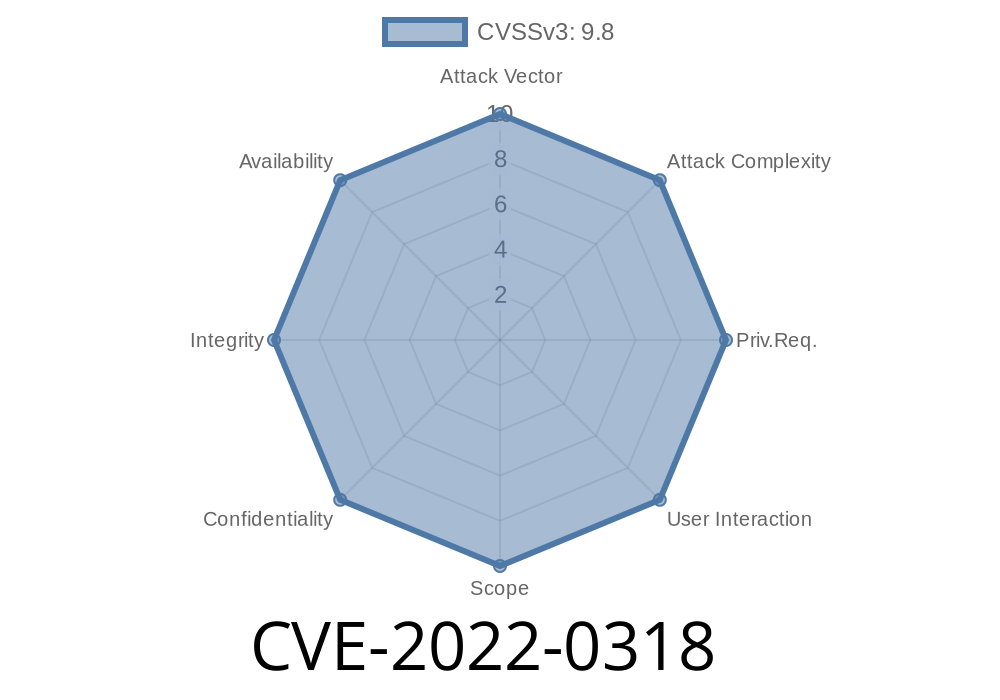
If you use Vim, the popular text editor, understanding recent vulnerabilities is essential to staying secure. One such issue is CVE-2022-0318—a noteworthy heap-based buffer overflow vulnerability affecting Vim versions before 8.2. In this article, we’ll break down the vulnerability in simple terms, show you code snippets for illustration, provide original references, and discuss how attackers might exploit it.
What is CVE-2022-0318?
CVE-2022-0318 is a heap-based buffer overflow vulnerability that exists in Vim due to improper handling of certain text input while processing modelines. Essentially, Vim can be tricked into writing more data than it should into an allocated space in memory, potentially allowing attackers to run harmful code.
- Affected versions: Vim/vim before 8.2
How Does It Happen?
Vim supports a feature called modelines. This allows special configuration lines within text files to adjust Vim’s behavior. Unfortunately, if these lines are crafted in a specific way, Vim can mishandle memory allocation, resulting in a buffer overflow.
Simplified Code Example
Here’s a simplified version based on the vulnerable code. This isn’t from Vim’s real source, but it helps illustrate what goes wrong:
void parse_modeline(char *line) {
    char buffer[256];
    // Unsafe copy: doesn't check the size of the line
    strcpy(buffer, line);
    // ... process modeline ...
}
If line is bigger than 256 bytes, strcpy will keep writing, overwriting adjacent memory in the heap. This overrun can corrupt execution flow or crash Vim.
In the real Vim source, the bug was in the way it parsed and copied modeline options, failing to check the length of input coming from files.
Links to Original References
- Vim Security Advisory
- CVE Record at MITRE
- Vim Patch 8.2
- NVD Record
Exploit Details: How Could It Be Exploited?
1. Craft a Malicious File:
An attacker would create a text file with an unusually long or malicious modeline, such as something like this at the top or bottom of the file:
# vim: set ts=4 sw=4 sts=4 expandtab:abcdefghijklmnopqrstuvwxyzABCDEFGHIJKLMNOPQRSTUVWXYZ0123456789...(repeat up to 500+ characters)...
2. Social Engineering or Drive-By:
The attacker sends this file to a victim, or places it in a shared directory, maybe disguised as code, documentation, or a config file.
3. Open in Vim:
When the victim opens this file in Vim (pre-8.2), the program tries to process the huge modeline, overwriting heap memory.
4. Resulting Impact:
Even worse, execute arbitrary code with the victim's privileges
> NOTE: Modern systems use memory protections but local code execution is possible, particularly if ASLR and stack canary aren't well implemented.
Here’s a basic proof-of-concept malicious file
This is a harmless start of file.
# vim: set ft=python ts=4 sw=4 expandtab:abcdefghijklmnopqrstuvwxyzabcdefghijklmnopqrstuvwxyzabcdefghijklmnopqrstuvwxyz...(more to overflow buffer)...
Open this file with Vim before version 8.2 and it could crash or misbehave.
How Was It Fixed?
Vim’s maintainers patched the function to guarantee buffer sizes are correctly checked and handled, so too-long modelines are simply truncated or rejected, avoiding memory corruption.
Patch excerpt
// Example of a safe copy
strncpy(buffer, line, sizeof(buffer) - 1);
buffer[sizeof(buffer) - 1] = '\';
// Now the buffer can't be overrun, even with long input
- Disable Modelines: If you don't need modelines, add the following to your .vimrc
set nomodeline
Conclusion
CVE-2022-0318 demonstrates how even robust, popular tools like Vim can have hidden dangers. The heap-based buffer overflow stems from overlooking input size checks while handling modelines. Always keep your software up to date and be wary of what you open. For more, dive into the references above.
*Stay informed—stay safe. If you have questions or want more deep dives, let us know!*
Timeline
Published on: 01/21/2022 12:15:00 UTC
Last modified on: 08/21/2022 07:15:00 UTC