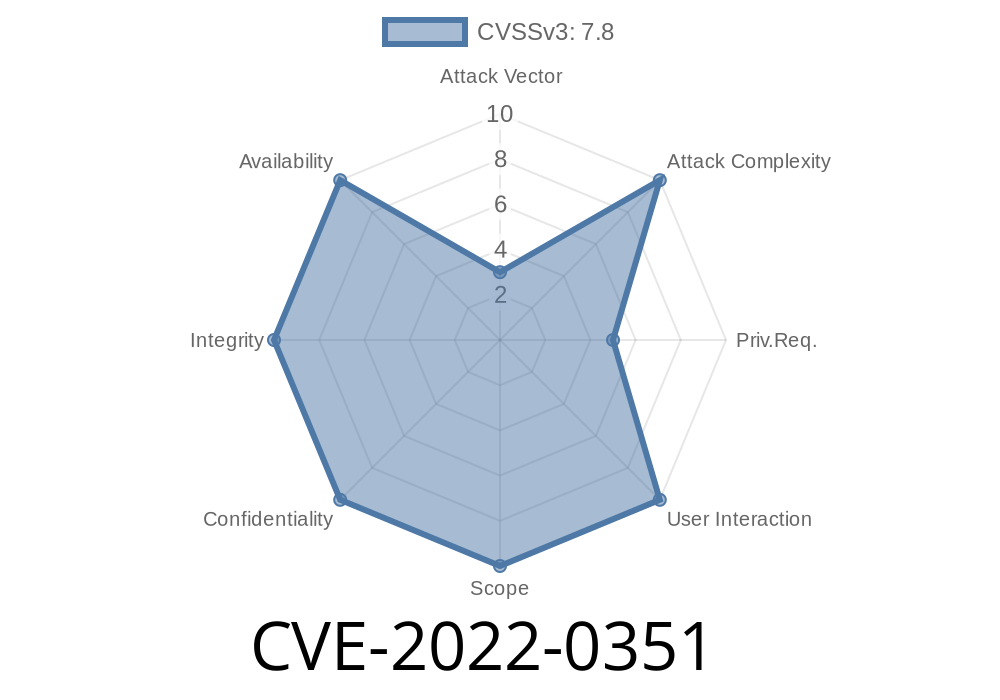
Vim is one of the most popular text editors, loved by developers worldwide for its speed and versatility. But even tools as trusted as Vim aren't immune to security flaws. In this post, we're diving into CVE-2022-0351 — a vulnerability that lets attackers access memory before the start of a buffer in Vim releases before 8.2. We'll break down what happened, why it matters, and how attackers could exploit it, with code snippets and references to help you understand the risk.
What is CVE-2022-0351?
CVE-2022-0351 is a security bug classified as “Access of Memory Location Before Start of Buffer.” In simpler terms, it means there's a way for code running in Vim to accidentally—or maliciously—read memory that doesn't belong to the buffer it's operating on. This can lead to unpredictable behavior, crashes, or potentially give attackers access to sensitive data.
Official Reference
- NVD Entry for CVE-2022-0351
- Vim Security Advisories
- Upstream Patch Commit
The Technical Root: Buffer Underflow
In C programming (and thus in Vim's C codebase), a “buffer” is just a chunk of memory. Whenever code grabs text data to process, it grabs it from a buffer. If you ask for “the spot before the first spot,” you get unpredictable data.
In Vim’s source, there was an unsafe access to a buffer where the code could look at one (or more) bytes *before* the buffer actually started. Here’s how things might go wrong (simplified):
char *buf = allocate_buffer(SIZE);

// ... process input

char prev = buf[-1]; // <-- Unsafe! Accesses memory before 'buf'
Accessing buf[-1] is *not* OK—it can give garbage, crash the program, or expose sensitive memory if attackers are clever.
The Flaw Inside Vim
The bug was discovered in Vim’s handling of certain text manipulations. When Vim was processing lines, an internal function could end up reading memory just before the start of a buffer. This error could be triggered if you opened a specially crafted file or ran certain commands inside Vim.
Vim processes the file, and a function tries to read past the start of a text buffer.
3. This causes Vim to access adjacent memory, which could lead to exposure of unexpected data or a crash.
From Research and Exploit Discussions
The commit fixing the issue refines how Vim checks pointer boundaries before accessing previous characters in a text buffer.
A snippet from the patch
if (p > buf)
    prev = *(p - 1);
else
    prev = NUL;
The fix checks—“Is the pointer within the buffer before reading backwards?”
Exploiting the Bug
This vulnerability isn’t like a classic “remote code execution” bug—but it’s not harmless, either. A crafty attacker can weaponize this in several ways:
- Info Leak: By slipping clever content into a text file, an attacker could trick Vim into leaking memory from before the buffer. This memory might contain data from other processes, files, or sensitive internal Vim data.
- Crash / Denial-of-Service: If the underflow causes Vim to crash, a malicious file could be used to “booby-trap” developer environments.
Here’s a concept of how someone might attempt to trigger the bug (pseudocode)
" Exploit.vim - crafted file to trigger buffer underflow
call setline(1, repeat('A', 100))    " Fill buffer with 'A's
" Force a function to look before buffer start:
call feedkeys("\<C-A>", 'n')
" Outcome: may cause crash or expose memory (depends on version)
(Exact code to trigger the vulnerability may differ, but this illustrates the risk: opening bad files or running untrusted macros in outdated Vim can be dangerous!)
If you’re using version 8.2 or newer, you’re protected.
Download the latest version at vim.org or update via your OS package manager.
Additional Resources
- Full Patch Fix
- cve-database.com write-up
- Vim Release Notes
Wrapping Up
Bugs like CVE-2022-0351 remind us that even the best tools can have critical flaws. Keeping your software patched, and using safe practices when working with files, is your first line of defense!
Timeline
Published on: 01/25/2022 18:15:00 UTC
Last modified on: 08/29/2022 18:59:00 UTC