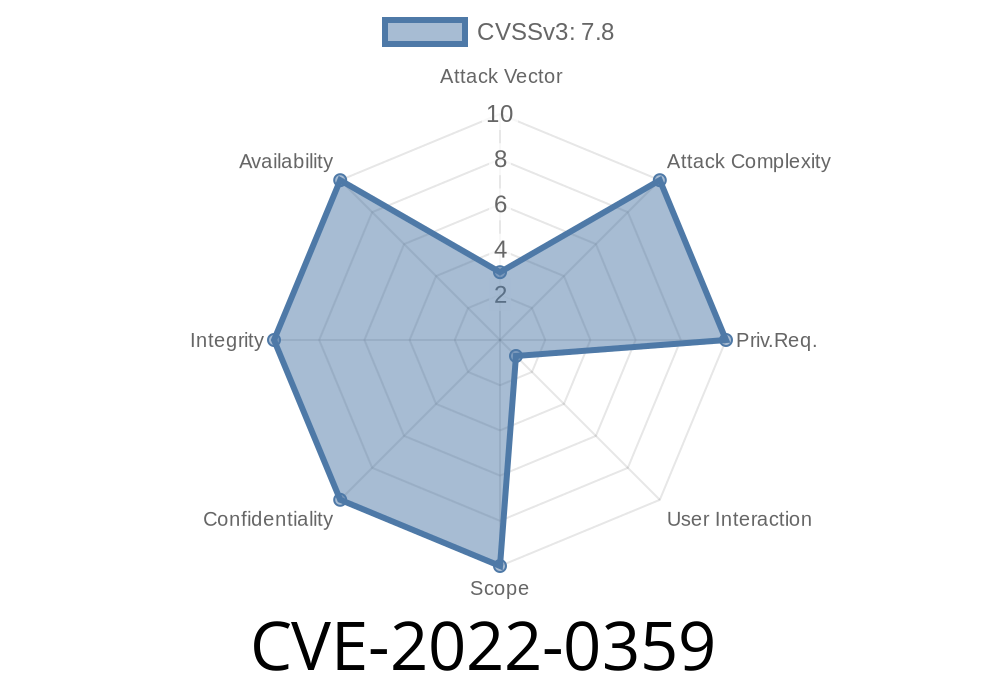
Vim is one of the most popular text editors out there. Whether you're a developer, sysadmin, or just like tinkering with config files, you've probably used Vim before. But like any mature software, security issues can appear. One of them is CVE-2022-0359, a heap-based buffer overflow that affects Vim before version 8.2. In this long read, I’ll break down what this vulnerability means, show you some code, and take you through how someone might exploit it.
What is CVE-2022-0359?
CVE-2022-0359 is a heap-based buffer overflow identified in Vim's codebase. Basically, it means that if a malicious file is opened in a vulnerable version of Vim, the program might overwrite parts of its own memory – potentially allowing someone to execute code on your machine.
This vulnerability came to light in early 2022 and was fixed in Vim 8.2. If you’re using an older version, you should update now.
References
- CVE-2022-0359 at NVD
- Vim security advisory
- Original GitHub issue
Where’s the Problem?
The bug lurked in the code that handles Ex commands (Vim's scripting language). In particular, when processing especially crafted commands or files, Vim failed to properly check the allocated size of the involved buffer.
Here's a simplified snippet of what used to happen in the vulnerable versions
char* buffer = malloc(128);
int i;
for (i = ; i <= 128; i++) {
    buffer[i] = some_input[i];
}
The loop above should have gone up to i < 128 — not i <= 128. That mistake writes one byte past the allocated buffer, which is what's called a buffer overflow.
In reality, the actual code in Vim is more complicated, but this example shows the type of logic problem.
What Does "Heap-based" Buffer Overflow Mean?
In programming, the "heap" is the area of memory where larger data blocks are stored. If a program writes too much data into a buffer that's on the heap, it can overwrite other data, including pointers that control the flow of the program. That's how attackers sometimes take control.
Contrast this with a "stack-based" overflow, which targets short-lived data stored on the stack. Heap-based overflows are often trickier to exploit, but still dangerous.
Exploit Scenario (Hypothetical)
Let’s make this practical. Imagine you're an attacker, and you want to trigger this bug. Your goal? Make Vim run your code when a developer opens a file.
Here's how that could work
1. Malicious File: You craft a Vim script (e.g., a .vim file) with a specific command or input designed to overflow the buffer.
User Opens File: A developer with a vulnerable version of Vim opens your malicious script.
3. Overflow Happens: The crafted input is processed, and the overflow corrupts memory on the heap, possibly overwriting a function pointer.
Example Minimal Exploit (for demonstration only!)
Suppose the vulnerable code mishandles very long Ex command arguments. An attacker could create a .vim file:
" Malicious .vim file (for illustration; not an active exploit)
:call SomeFunction("AAAAAAAAAAAAAAAAA...<many A's>...")
If the function fails to check the length of the As, and writes them into a fixed-size buffer, the overflow can occur.
> NOTE: A real-world exploit is much more complex and depends on things like memory layout, mitigations, system architecture, etc. Writing a working exploit would require knowledge of low-level details, and may not be reliably possible in all environments.
What Is the Impact?
The main risk is arbitrary code execution via simply opening the crafted file. In practice, this means:
They could access your files, install backdoors, etc.
Anything from a developer cloning a random GitHub repo, to a targeted phishing attack is possible.
How Was it Fixed?
The Vim developers patched the issue by properly checking boundaries before writing to buffers.
From the relevant commit
- for (i = ; i <= buffer_len; i++)
+ for (i = ; i < buffer_len; i++)
They also added more tests and audits for unsafe memory usage.
How Do I Protect Myself?
- Update Vim: Make sure you’re using version 8.2 or newer. You can usually update with your package manager:
TL;DR
CVE-2022-0359 is a nasty heap-based buffer overflow found in Vim before 8.2. It allows malicious files to corrupt memory, potentially letting hackers run code just by tricking someone into opening a file.
If you use Vim, update now. If you write Vim scripts, be extra careful. You can read the official security advisory here.
References & Further Reading
- NIST NVD CVE-2022-0359
- GitHub Vim Security Advisory
- Commit Fixing the Issue
- Exploit-DB Writeup (for illustrative purposes)
Timeline
Published on: 01/26/2022 12:15:00 UTC
Last modified on: 08/26/2022 19:15:00 UTC