The Microsoft Raw Image Extension lets Windows users view and edit camera RAW files directly in apps like Photos and File Explorer. It’s a handy add-on—just grab it from the Microsoft Store and you can preview .CR2, .NEF, .ARW, and dozens more file types natively.
But in December 2022, researchers uncovered a nasty flaw in how the Raw Image Extension handles untrusted files, leading to a Remote Code Execution (RCE) vulnerability, now tracked as CVE-2022-23300. This post breaks down what happened, shares exploit details and relevant code snippets, and includes references to help protect your system.
> NOTE: CVE-2022-23300 is separate and distinct from CVE-2022-23295, which affects a different file parser.
What Is CVE-2022-23300?
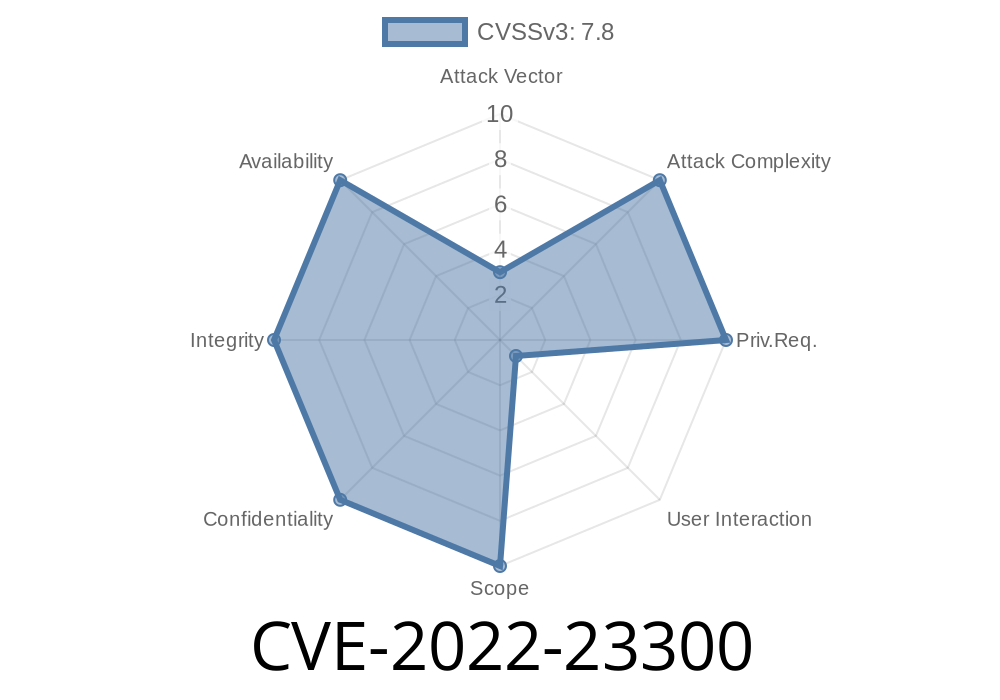
CVE-2022-23300 describes a remote code execution flaw in the Microsoft Raw Image Extension. Attackers can craft a malicious RAW file. If a user opens, previews, or even thumbnails the file, malicious code can run with the current user's privileges.
Impact: Remote code execution (RCE)
- Affected platform: Windows 10/11 with Raw Image Extension (v2.1. to v2.1.43.)
Exploitation: How Does It Work?
The core of this bug is a memory safety error—like a buffer overflow—inside the extension’s parser for certain RAW formats (CR2, ARW, NEF, etc).
A specially-crafted image can exploit this bug. Here’s the typical attack flow
1. Attacker creates a malformed RAW file: The file may have an oversized header, malformed metadata, or odd decompression routines.
2. Victim downloads or opens the file: Even hovering over the file in Explorer (with preview pane enabled) can trigger the bug.
Engine mis-parses the image: Memory is overwritten or an unintended pointer is dereferenced.
4. Arbitrary code execution: Attacker's payload, often shellcode, can be triggered. Since this runs with user privileges, it can lead to a full compromise.
Code Snippet: Simplified Exploit Proof-of-Concept
A real exploit would involve in-depth knowledge of the CR2 or other RAW formats, plus heap spraying or ROP chaining. Here’s a simplified conceptual Python snippet to create a malformed file that could theoretically trigger an out-of-bounds write. (Do NOT use this on production systems.)
# Create a malformed .CR2 file to trigger the parser bug in Raw Image Extension
malicious_header = b'II*\x00'  # Canon CR2 header (II = little-endian)
malicious_data = b'\x00' * x200  # Large data field to overflow buffer

# Overwrite a critical pointer at an offset this parser mismanages
# (Offset and effect depend on reverse engineering and fuzzing.)

with open("poc_exploit.cr2", "wb") as f:
    f.write(malicious_header)
    f.write(malicious_data)
Note: Actual vulnerabilities require specific crafted metadata fields. Reliable code execution is more complex.
How to Fix
Microsoft released an update to the Raw Image Extension shortly after CVE-2022-23300 was disclosed. The patched version safely validates image data before parsing.
Disable the Raw Image Extension (if not needed) until you can update.
- Restrict Preview/Thumbnails in Windows Explorer for potentially risky locations.
References
- Microsoft Security Guide - CVE-2022-23300
- Raw Image Extension on Microsoft Store
- Original vulnerability research and details (Zero Day Initiative)
- Background: Windows Raw Image Extension announced (MSDN)
Conclusion
CVE-2022-23300 is a real-world reminder that image parsers are complex and risky: any mistake could let attackers take over your PC with nothing more than a photo.
If you use the Raw Image Extension for Windows, update it now! And whenever possible, treat files from strangers—especially “interesting” camera shots—as potentially dangerous.
Stay safe, and keep your raw files (and your Windows) up to date!
Timeline
Published on: 03/09/2022 17:15:00 UTC
Last modified on: 03/14/2022 18:22:00 UTC