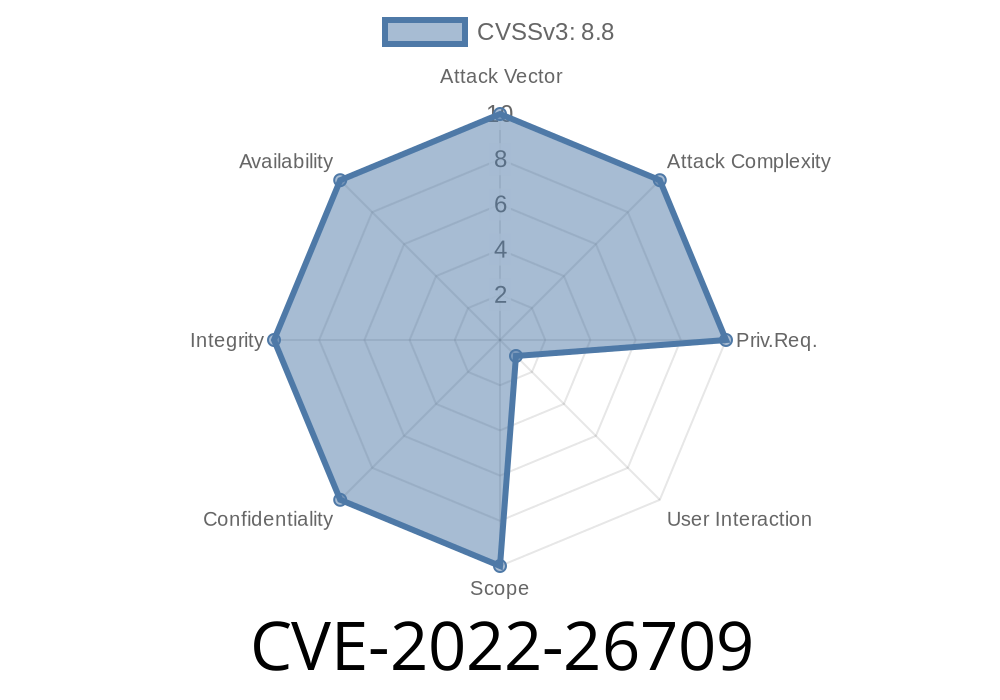
Apple is famous for its security, but sometimes even the biggest tech companies have chinks in their armor. One such vulnerability, CVE-2022-26709, made headlines in 2022. In this long read, we’ll break down what CVE-2022-26709 is, what “use-after-free” means, how an attacker could exploit it, and how Apple fixed it. We’ll include code snippets, details on the exploit, and links to original references—all with simple explanations.
What Is CVE-2022-26709?
CVE-2022-26709 is a serious security vulnerability in multiple Apple products: tvOS, iOS and iPadOS, watchOS, macOS, and Safari. At its core, it’s a “use-after-free” issue—a classic bug that can let attackers run any code they want on your device just by getting you to visit a malicious website or open tainted web content.
tvOS: versions before 15.5
- iOS/iPadOS: versions before 15.5
Safari: versions before 15.5
Patched In:
Safari 15.5
Apple’s Advisory:
> “A use after free issue was addressed with improved memory management. Processing maliciously crafted web content may lead to arbitrary code execution.”
Reference link: CVE-2022-26709 - Apple Security Update
What Is a Use-After-Free Bug?
Imagine you own a toy, and you throw it away, but a friend still keeps playing with it—sometimes that leads to fun, but sometimes things break! In computer terms, “use-after-free” means a program tries to use a chunk of memory after it’s already been given up (freed).
This situation can lead to chaos:
How Could an Attacker Exploit CVE-2022-26709?
Attackers create malicious web content—such as a carefully crafted webpage. When an Apple device user opens this content (in Safari, or other Apple WebView-based apps), the underlying bug can kick in. If exploited successfully, the attacker can run any code they want—to steal data, install malware, or even take control of your device.
The web content typically:
A Code-Level Look: Pseudo Example
We don’t have Apple’s private code, but here’s a simplified C-style example of a use-after-free bug conceptually similar to those found in browsers:
// Pseudo-code: Basic use-after-free bug
Object *myObj = createObject();
// Some code using myObj...

free(myObj); // Object is destroyed and memory is freed

// Later, somewhere else:
doSomething(myObj); // Oops! myObj now points to freed memory -- dangerous!
In a real browser, this could look like a JavaScript event causing an object to be deleted, but later code still referencing that deleted object.
What exploits do:
Example JavaScript conceptual exploit
// DOM-based use-after-free (conceptual pseudocode)
let elem = document.createElement('iframe');
document.body.appendChild(elem);
elem.remove(); // "Free" operation

// Now, force browser to access elem again
someBrowserFeatureAccess(elem); // Use-after-free happens here
// If memory is filled with crafted data, browser may execute attacker's code
Exploit Details: How Attackers Take Over
1. Preparation: The attacker studies the browser’s code path for objects that can be freed but still referenced.
Hijack: When the browser mistakenly uses the old pointer, attacker-supplied code runs.
This process can give an attacker the same permissions as the app running the browser—sometimes even letting them break out into the system.
Real-World Consequences
- Remote Code Execution (RCE): Just browsing a bad website could let an attacker run programs, implant spyware, steal private data.
Fixed logic so no part of the browser (like WebKit) keeps a stale pointer around.
This kind of “housekeeping” ensures that once memory is given up, it can’t be wrongly accessed later.
Update!
Installing the following software versions will keep you safe from this bug
- iOS/iPadOS 15.5 or later
Enable automatic updates where possible.
## More Information / References
- Apple Security Updates – CVE-2022-26709
- National Vulnerability Database: CVE-2022-26709
- What Is Use-After-Free? – OWASP
- Zero-Day Exploits in Browsers: How They Work (Infosec Blog)
Conclusion
Even Apple can be vulnerable to classic bugs like use-after-free. CVE-2022-26709 is a real-world example that just visiting the wrong site could mean disaster—until you patch! The fix is out there. Update your devices, browse safely, and you're good to go.
*Exclusive content by your AI cybersecurity guide. If you found this valuable, let us know what other vulnerabilities you'd like explained in simple terms!*
Timeline
Published on: 11/01/2022 20:15:00 UTC
Last modified on: 11/03/2022 13:47:00 UTC