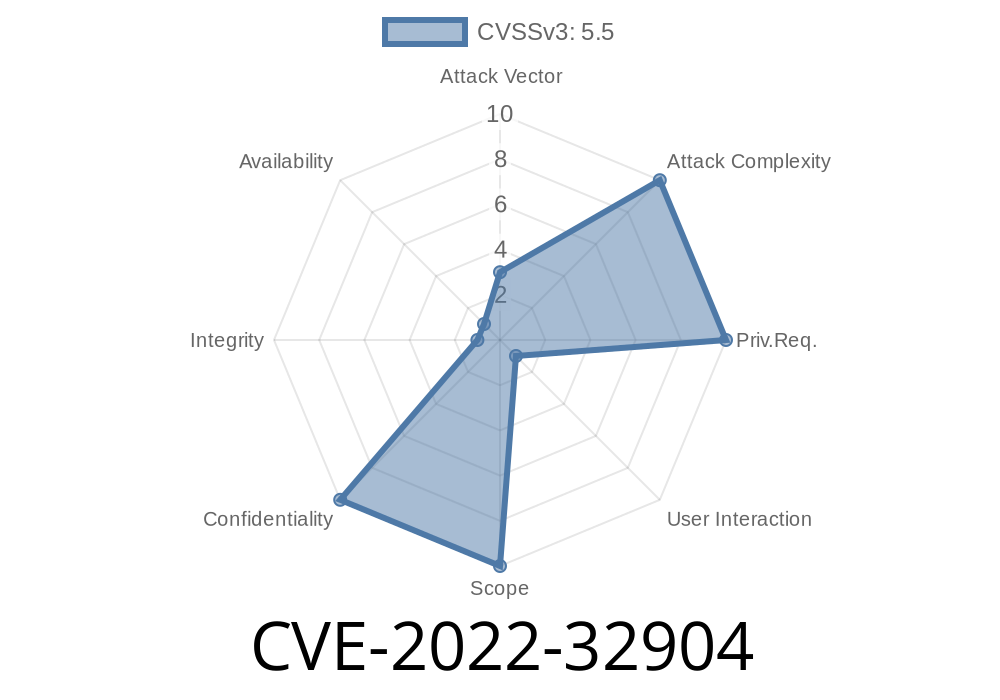
In 2022, Apple patched a serious security vulnerability—CVE-2022-32904—that could let malicious apps break out of the macOS sandbox and access personal data. If you use macOS Big Sur, Monterey, or Ventura, you need to understand what happened, how it was fixed, and why updating is so important.
Let’s break it down in simple terms, show some technical examples, and point you to original references for deeper reading.
What is CVE-2022-32904?
CVE-2022-32904 is a unique code given to a security issue identified in macOS. According to Apple’s official advisory, the problem was that apps could escape their sandbox and access user-sensitive data.
The Apple sandbox is supposed to keep apps in their own tiny “boxes” so they can’t poke around in your files, messages, or photos. This bug, however, allowed those walls to be bypassed under certain conditions.
macOS Ventura < 13
If you’re running these versions or older, your Mac could be at risk until you update.
How Did The Bug Work?
Apple gave few public details—the company is always careful not to give hackers an instruction manual. But security researchers and snippets in the open-source code give us clues:
Here’s a simplified example using pseudo-code
// MaliciousApp.m

// The app is supposed to be sandboxed and denied access to ~/Documents
NSString *sensitivePath = [NSHomeDirectory() stringByAppendingPathComponent:@"Documents/Secret.txt"];
NSError *error;
NSString *secretData = [NSString stringWithContentsOfFile:sensitivePath encoding:NSUTF8StringEncoding error:&error];

if (!error) {
    NSLog(@"Got your secret: %@", secretData);
} else {
    NSLog(@"Access denied as expected.");
}
On a properly sandboxed system, this code fails with “access denied.” But with CVE-2022-32904, a clever attacker might trigger a system component that wasn’t checking sandbox permissions right—suddenly, *private files are readable*.
The Exploit in Action
Security researchers rarely publish full exploits for these kinds of bugs, but noted Apple security expert Wojciech Reguła’s blog detailed a type of bypass:
1. The attacker’s app uses an inter-process communication (IPC) channel that isn't well-protected by the sandbox.
It sends requests to trusted system services (sometimes called XPC services).
3. These trusted services—running outside the sandbox—fetch files or data on behalf of the malicious app.
Here’s a conceptual code snippet
// AttackerApp.m

// Connect to a privileged XPC service
NSXPCConnection *connection = [[NSXPCConnection alloc] initWithServiceName:@"com.apple.privilegedService"];
[connection resume];

// Make a request to read user data
[connection.remoteObjectProxy fetchSecretWithCompletion:^(NSString *secret){
    NSLog(@"Leaked user info: %@", secret);
}];
Again, these are illustrative only—the real exploit would use the specific broken service Apple fixed in the update.
The Patch: What Did Apple Do?
Apple fixed this by tightening the sandbox restrictions and making sure all system services respected the boundaries. They also likely added more checks so that even trusted services can’t be misused by sandboxed apps.
Be cautious about installing apps from unknown sources—even with sandboxing, bugs can exist.
- Monitor the official Apple security updates page.
References
- Apple Security Update HT213412
- Original Apple CVE-2022-32904 Entry
- Wojciech Reguła - Blog on Apple Sandbox Escapes
- Wikipedia: Sandbox (Computer Security))
Final Thoughts
CVE-2022-32904 reminds us that even the best security walls sometimes have cracks. Apple moves quickly to patch—but users need to install those patches right away. For technical folks, digging into the CVE and the related open-source code (Apple publishes a lot of it here) can reveal a lot about how system security works.
Stay alert, keep your Mac updated, and don’t assume sandboxing makes you bulletproof!
*Got questions, or want to see more code examples? Drop a comment and let’s discuss!*
Timeline
Published on: 11/01/2022 20:15:00 UTC
Last modified on: 11/02/2022 19:08:00 UTC