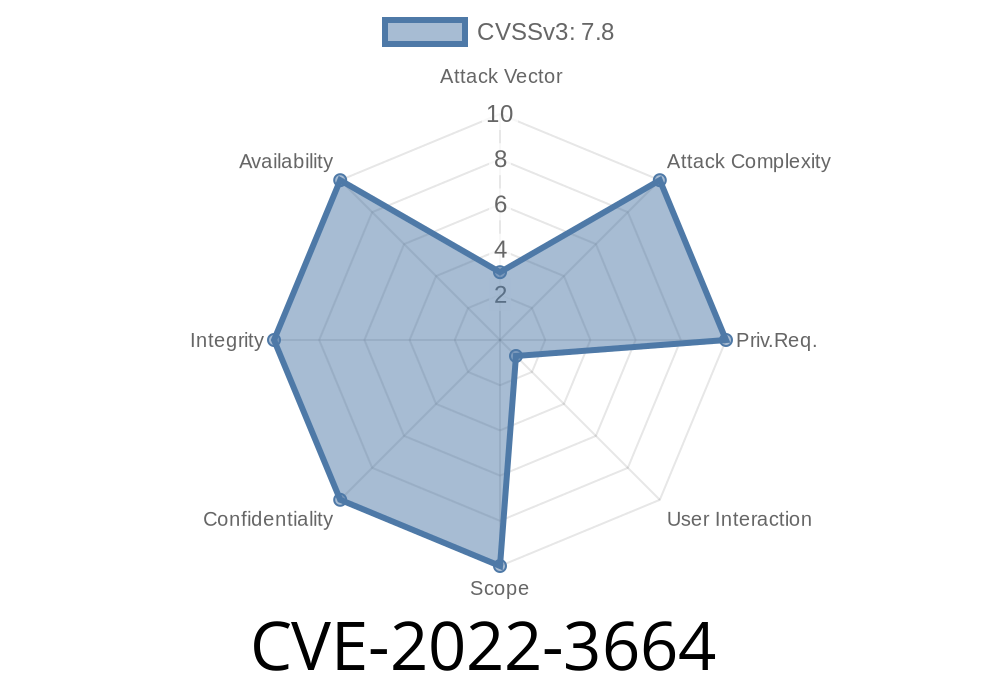
A serious security issue—CVE-2022-3664—has been identified in the popular multimedia library Axiomatic Bento4. This bug affects the AP4_BitStream::WriteBytes function in the Ap4BitStream.cpp source file, specifically when handling certain types of input in the avcinfo component. If you or your company processes or analyzes MP4 and other ISO base media file formats using Bento4, you should pay very close attention to this critical vulnerability.
This post will walk you through what CVE-2022-3664 is, provide clear code snippets, explain how the exploit works, and point you to the original references, all in easy-to-understand language.
💡 Overview of the Vulnerability
CVE-2022-3664 is a heap-based buffer overflow vulnerability reported in Bento4 (see VDB-212004). An attacker can trigger this bug remotely, just by sending a crafted file or network data to a vulnerable system using Bento4, causing the program to write outside the boundaries of allocated memory. This can lead to a crash, information leak, or even remote code execution.
Function: AP4_BitStream::WriteBytes
- Component: avcinfo (typically used for parsing AVC/H.264 info)
⚠️ Technical Details
The cause of this vulnerability lies in insufficient boundary checks inside the WriteBytes function. When an attacker supplies more bytes than the output buffer can handle, and the code doesn't check the size, it writes past the end of the buffer. This classic mistake is called a heap buffer overflow.
Here’s a simplified, illustrative snippet of what a vulnerable code might look like
void AP4_BitStream::WriteBytes(const unsigned char* data, unsigned int size) {
    // Vulnerable: No check if m_Buffer has enough space
    memcpy(m_Buffer + m_Position, data, size);
    m_Position += size;
}
The above function writes size bytes from the user-supplied data into m_Buffer starting at m_Position. But—if m_Buffer is not big enough, memory after the buffer can get overwritten!
How can an attacker use this?
If an attacker sends a specially crafted media file (or input data) that tricks the program into writing more data than the buffer can hold, the program may:
Simple PoC (Proof-of-Concept)
Suppose you have an executable linked with vulnerable Bento4 code (for example, avcinfo or other Bento4-based utilities). Here’s what a malicious input could look like in pseudo-code:
# Let's imagine an attacker creates a malformed MP4 file with AVCC data field.

# input_file.mp4 (crafted for overflow)
# This is just an example. An actual exploit would require constructing a valid MP4 envelope.

malicious_bytes = b"\x00" * 10000  # Overly long buffer supplied on purpose

with open("malicious.mp4", "wb") as f:
    f.write(b"\x00\x00\x00\x18ftypmp42")  # MP4 header
    f.write(malicious_bytes)
By feeding such a file into a vulnerable utility
./avcinfo malicious.mp4
…the program might crash or let the attacker run their code, depending on system protections.
👀 Real-World Impact
- Remote attackers could exploit this bug simply by getting a user to open or analyze a malicious file.
Any applications or services using Bento4 libraries for file parsing are at risk.
- This flaw is especially dangerous if processed files come from untrusted sources (e.g., web uploads).
🔗 References & Further Reading
- CVE-2022-3664 at cve.org
- VulDB VDB-212004 Advisory
- Bento4 GitHub Repository
- Exploit-DB PoC *(if available)*
🛡️ How to Fix It
- Upgrade to the latest version of Bento4 as soon as possible; patches are typically available in the official repo.
💬 Final Words
CVE-2022-3664 is a critical vulnerability that can endanger any software relying on Bento4 for parsing or analyzing media files. Making sure your library or application is patched is essential for system security. The bug is public, and working exploits exist—take this seriously!
Stay safe, stay updated—and always validate input!
Timeline
Published on: 10/26/2022 19:15:00 UTC
Last modified on: 10/28/2022 17:29:00 UTC