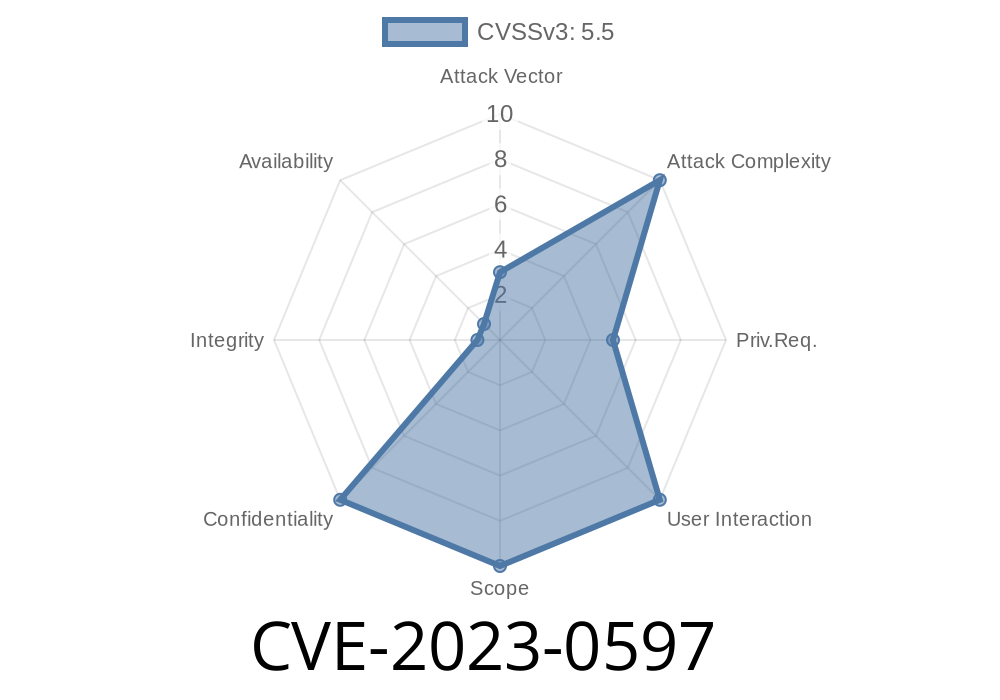
CVE-2023-0597 is a security bug found in Linux kernel's handling of the cpu_entry_area—a part of memory where the kernel puts CPU-specific data, like exception stacks and task info. Because of this flaw, a regular (non-root) user can figure out exactly where certain kernel data lives in memory, potentially leading to leaks of sensitive info.
To understand why this matters, let’s take a closer look at what the cpu_entry_area does, why it got mapped where it did, and exactly how someone might use CVE-2023-0597 on a vulnerable Linux system.
Why cpu_entry_area Matters
The cpu_entry_area was introduced to separate out per-CPU data from the main kernel space. This makes it safer and faster for the kernel to do low-level stuff, like handling interrupts or keeping track of the stack for each CPU.
But for performance reasons, this data gets mapped in fairly predictable, user-accessible memory ranges for each CPU core—like this:
struct cpu_entry_area *cea = get_cpu_entry_area(smp_processor_id());
The flaw? The location in virtual memory where these areas are mapped is _guessable_ by userspace, and now, some exception stack or sensitive CPU data might end up at predictable addresses.
How The Leak Works
A local user doesn't need fancy privileges to try and guess the location of kernel data. This becomes a problem if the kernel also puts sensitive data—like exception stack pointers, task info, or even KASLR (Kernel Address Space Layout Randomization) offsets—into this area.
Craft attacks to read or even modify sensitive areas if another bug allows it
Example scenario:
Suppose you have a process that crashes (triggers a kernel oops or panic), a local user might be able to probe the memory map and, using timing or side channels, guess where the exception stack for their CPU will show up, then try to extract info either via direct memory reads (if they find another bug) or by using that info for another attack.
Exploit Details (Example)
Here’s a simplified code snippet showing how the cpu_entry_area is mapped (from Linux kernel source):
#define CPU_ENTRY_AREA_BASE xfffffe000000000UL

static inline struct cpu_entry_area *get_cpu_entry_area(int cpu)
{
    return (struct cpu_entry_area *)(CPU_ENTRY_AREA_BASE +
        cpu * sizeof(struct cpu_entry_area));
}
So if you know the CPU_ENTRY_AREA_BASE and the size, you can calculate where any CPU’s area is in memory. If you can get the cpu number (hint—for your own process, this is usually possible using sched_getcpu()), you can pinpoint the cpu_entry_area in memory.
`
3. Look for side-channels or related kernel bugs to access (read/write) at or near this address.
4. Scrape leaked kernel stack pointers, exception data, or other juicy info to build further attacks.
Mitigation and Fix
The kernel community has patched CVE-2023-0597 by randomizing or restricting the mapping and access patterns, making it much harder for userspace to guess or interact with these locations in memory.
> Patch summary:
> * Hardened cpu_entry_area mapping logic.
> * Improved separation of user and kernel data.
> * Added checks to prevent info leaks.
How do I stay safe?
- Update your kernel: Make sure you run a Linux kernel version after the fix (check your distro's security bulletins).
References
- Red Hat CVE Page
- Debian Security Tracker
- Upstream kernel amendment (LKML)
- Official NVD CVE Record
Conclusion
CVE-2023-0597 shows how important it is to pay attention to even subtle mapping details in the OS kernel. What looks like a harmless layout shortcut can open up avenues for info leaks and privilege escalations.
If you're running Linux—especially in a multi-user environment—make sure your kernel is up to date so that predictable mapping bugs like this don't come back to haunt you.
Timeline
Published on: 02/23/2023 20:15:00 UTC
Last modified on: 03/03/2023 15:59:00 UTC