A new security hole, CVE-2023-22044, affects several popular Java products from Oracle—including Java SE and GraalVM’s enterprise releases. In simple terms, this bug could let an attacker—without needing to log in—access sensitive information if the attack is pulled off correctly. Let’s break it down, see how the exploit works, and what real risks you’re facing.
1. What Exactly Is CVE-2023-22044?
CVE-2023-22044 is a vulnerability in the “Hotspot” part of Oracle Java SE, GraalVM Enterprise Edition, and GraalVM for JDK. Hotspot is the engine that executes Java code behind the scenes.
Oracle GraalVM for JDK: 17..7, 20..1
Unlike many Java vulnerabilities, this one is hard to exploit (Oracle ranks it “High” on complexity), but if exploited, attackers can read data they aren’t supposed to. They can’t delete or change data, but confidential info might leak.
Can use multiple protocols to deliver the attack, possibly via web APIs
The real danger is in environments where Java receives data from outside sources, like web services or APIs, and processes it using the vulnerable component.
Example Scenarios
- A Java server running a vulnerable version parses user-provided input through a REST API, SOAP service, or even file upload mechanisms.
- A desktop Java application running untrusted code from the internet (like a Java Web Start app or applet).
3. Technical Exploit Details
Oracle labels this as a data disclosure in Hotspot’s APIs. That means client or server code that exposes certain Java APIs to input from users may (unknowingly) leak data outside the intended security context.
Proof of Concept: A Hypothetical Example
Oracle hasn’t released full exploit code. But researchers and the pattern of past vulnerabilities suggest the abuser might use crafted serialized objects or malformed input to trick Hotspot/JVM into revealing data.
Here’s a simplified illustration (for educational purposes only)
import java.io.*;

public class CVE_2023_22044_Exploit {
    public static void main(String[] args) throws Exception {
        // Malicious input simulating what a web service might receive
        byte[] craftedInput = createMaliciousPayload();
        // A vulnerable deserialization point
        ObjectInputStream ois = new ObjectInputStream(new ByteArrayInputStream(craftedInput));
        Object data = ois.readObject();

        System.out.println("Received object: " + data);
    }

    private static byte[] createMaliciousPayload() {
        // Here, an attacker could craft a payload triggering the bug.
        // This is just a placeholder for the concept.
        return new byte[] { /* crafted binary data */ };
    }
}
In a real attack, the exploit could target serialization, reflection, or some internal Hotspot code, taking advantage of how trusted and untrusted Java code interact.
No integrity or availability impact
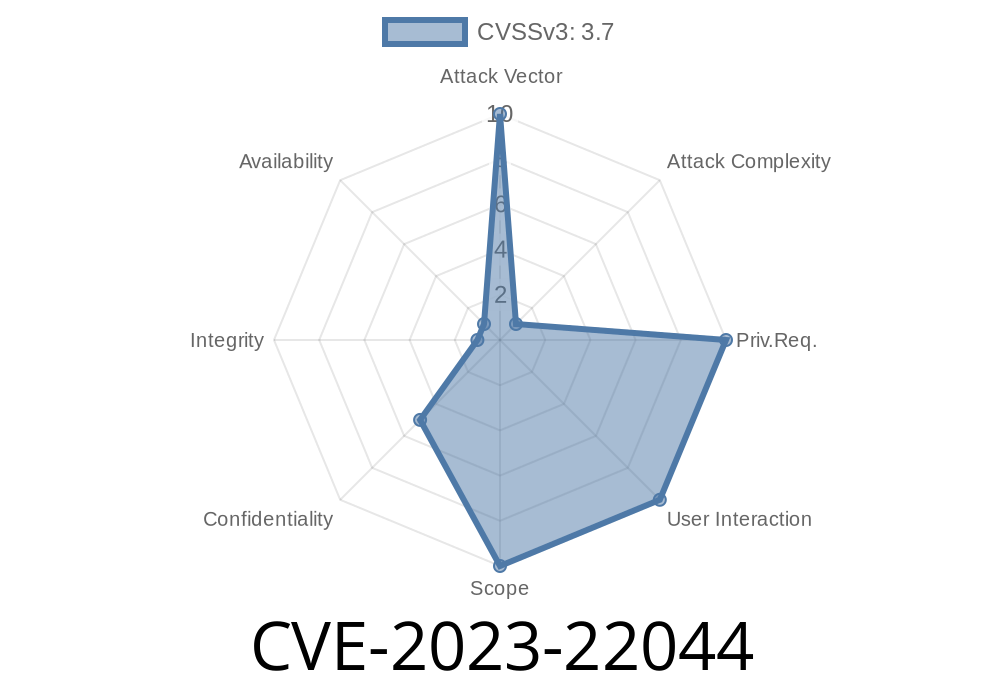
- CVSS String: CVSS:3.1/AV:N/AC:H/PR:N/UI:N/S:U/C:L/I:N/A:N
Bottom Line: No direct system takeovers, no ransomware—just data exposure.
5. How to Stay Safe
Oracle’s recommendation:
*PATCH YOUR JAVA AND GRAALVM INSTALLATIONS.*
Very often, Java vulnerabilities are overlooked for months or years. If you run web-facing Java servers or client apps that run code from untrusted sources: update as soon as possible.
- Go to Oracle’s Critical Patch Update Advisory - July 2023.
Download fixed versions for Java SE and GraalVM (Oracle backports security fixes fast).
- For alternative distributions (Adoptium, Amazon Corretto, etc.), check for vendor-specific advisories.
6. References and Further Reading
- Oracle Security Alert Advisory - CVE-2023-22044
- Oracle Critical Patch Update Advisory - July 2023
- National Vulnerability Database Entry
- GraalVM Releases & Security
> Note: As of writing, there is no public working exploit—details are based on public advisories and common Java vulnerability patterns. Keep an eye on CVE feeds and security blogs for the latest updates.
7. Summary
- CVE-2023-22044 lets remote attackers read limited memory/data in Java SE and GraalVM (Hotspot-based) products if certain conditions are met.
Monitor your apps for unexpected or suspicious input processing behavior.
For developers and sysadmins: the easiest win is to stay patched and review how your Java code interacts with user-supplied data, especially when using serialization, reflection, or running untrusted code.
*Stay safe, stay updated. If your service uses Java, GraalVM, or lets users upload or send data for processing, this is a good time to check your patch level!*
Timeline
Published on: 07/18/2023 21:15:00 UTC
Last modified on: 07/27/2023 17:34:00 UTC