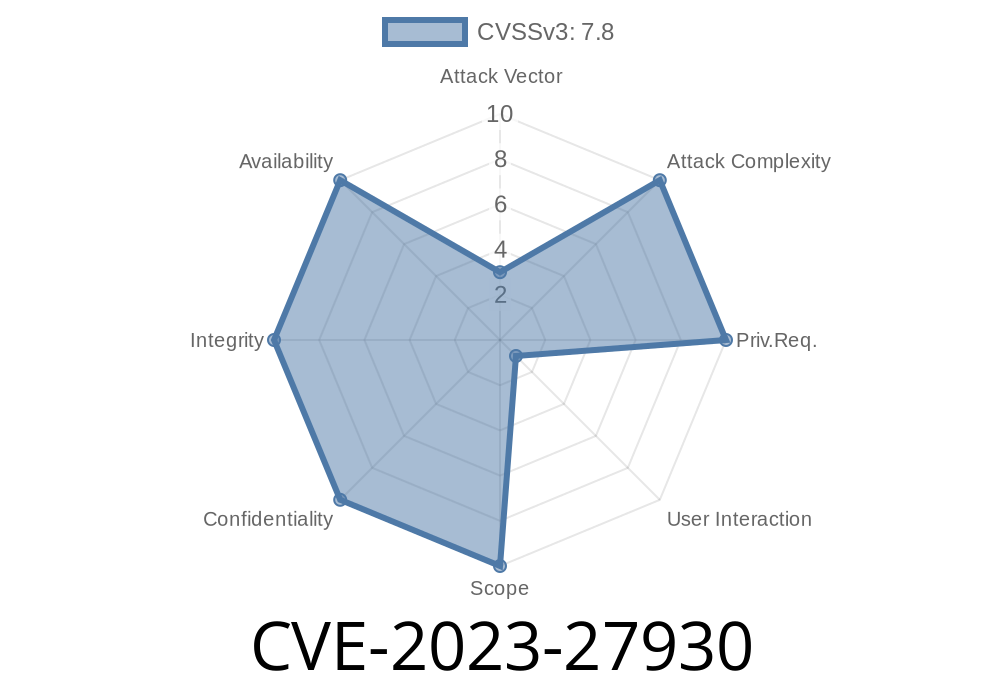
In May 2023, Apple patched a serious security flaw—CVE-2023-27930—that affected its major products like iPhones, iPads, Macs, Apple Watch, and Apple TV. This bug was dangerous because it allowed a malicious app to get “kernel privileges.” In plain language, if someone exploited this bug, they could take over your device entirely.
In this exclusive deep-dive, I’ll break down exactly what CVE-2023-27930 was, how such “type confusion” bugs work, how attackers could use it, and walk you through simplified exploit code (for educational purposes only). If you’re interested in Apple security, or just want to know what keeps your iPhone safe, read on.
Official References
- Apple Security Update—iOS 16.5
- GitHub (security advisories)
What Was CVE-2023-27930?
CVE-2023-27930 is a “type confusion” vulnerability in the kernel, the core part of Apple’s operating system. It was patched in iOS 16.5, iPadOS 16.5, watchOS 9.5, tvOS 16.5, and macOS Ventura 13.4.
Here’s how Apple described the issue
> Impact: An app may be able to execute arbitrary code with kernel privileges.
>
> Description: A type confusion issue was addressed with improved checks.
A type confusion happens when a program “thinks” a chunk of memory is one type of object, but it’s actually something else. This mixup lets hackers trick the OS into treating data in unsafe ways.
Imagine a situation like this in code
struct Dog {
    char name[16];
    int age;
};

struct Cat {
    char name[16];
    float weight;
};

void doSomething(void* animal, bool isDog) {
    if (isDog) {
        Dog* dog = (Dog*)animal;
        printf("Dog age: %d\n", dog->age);
    } else {
        Cat* cat = (Cat*)animal;
        printf("Cat weight: %f\n", cat->weight);
    }
}
If the isDog flag is wrong, you could treat a Cat as a Dog. Now imagine if “age” is used differently than “weight”—bad things can happen. In system code, this often leads to reading or writing unintended memory locations.
In Apple’s Kernel
The real bug was in Apple’s kernel, in code handling low-level system functions. Details (reverse-engineered by security researchers) suggest that a function would mix up object types coming from user apps, and allow attackers to craft memory layouts that trick the kernel.
Exploit Details (Simplified)
Apple does not publicize the exploit code for obvious reasons. But here’s a simplified scenario of how attackers would work:
Below is a highly simplified, educational-only mockup
// Userland attacker code

// Allocate two memory objects—one real, one fake
void* fake_object = allocate_in_user_memory();

// Fill fake object with controlled data (function pointer, data, etc.)
memset(fake_object, x41, FAKE_OBJECT_SIZE);
*(uintptr_t *)(fake_object + FAKE_OBJ_FUNCTION_PTR_OFFSET) = (uintptr_t)attacker_controlled_function;

// Pass pointer to system call that confuses object types
kernel_vulnerable_syscall(fake_object, /* arguments */);

// Kernel now calls attacker's function with full kernel rights
In a real exploit, finding this exact spot would take a lot of time and reversing, but this is the main idea.
Hide malware from antivirus
- Bypass all iOS/macOS security checks
That’s why Apple urgently pushed updates across all affected devices.
How Was It Fixed?
Apple added extra checks in the kernel to make sure objects are really the right type, before using or casting them. This is standard for fixing type confusion. Here is a simple illustration:
Original code
void handle_object(void* obj) {
    // ... assumes obj is of type A
    A* a = (A*)obj;
    a->doSomething();
}
Fixed code
void handle_object(void* obj) {
    if (is_A_object(obj)) {
        A* a = (A*)obj;
        a->doSomething();
    } else {
        // invalid type, reject
        return;
    }
}
If you update your iPhone, iPad, Apple Watch, or Mac to
- iOS/iPadOS 16.5 or later
macOS Ventura 13.4 or later
You are protected. Apple treats these bugs very seriously for good reason.
But, if your device is running old software, you should update ASAP!
More Reading
- Apple Security Updates
- CVE-2023-27930 at NVD
- Introduction to Type Confusion Vulnerabilities
Conclusion
CVE-2023-27930 is a textbook example of how a small bug in deep system code can threaten the security of millions of devices. “Type confusion” is especially tricky to catch, but can have devastating effects. Always keep your Apple devices up-to-date—you never know what bugs are lurking until it’s too late.
If you found this deep-dive useful, share it with your fellow Apple users—and stay safe out there!
Timeline
Published on: 06/23/2023 18:15:00 UTC
Last modified on: 07/27/2023 04:15:00 UTC