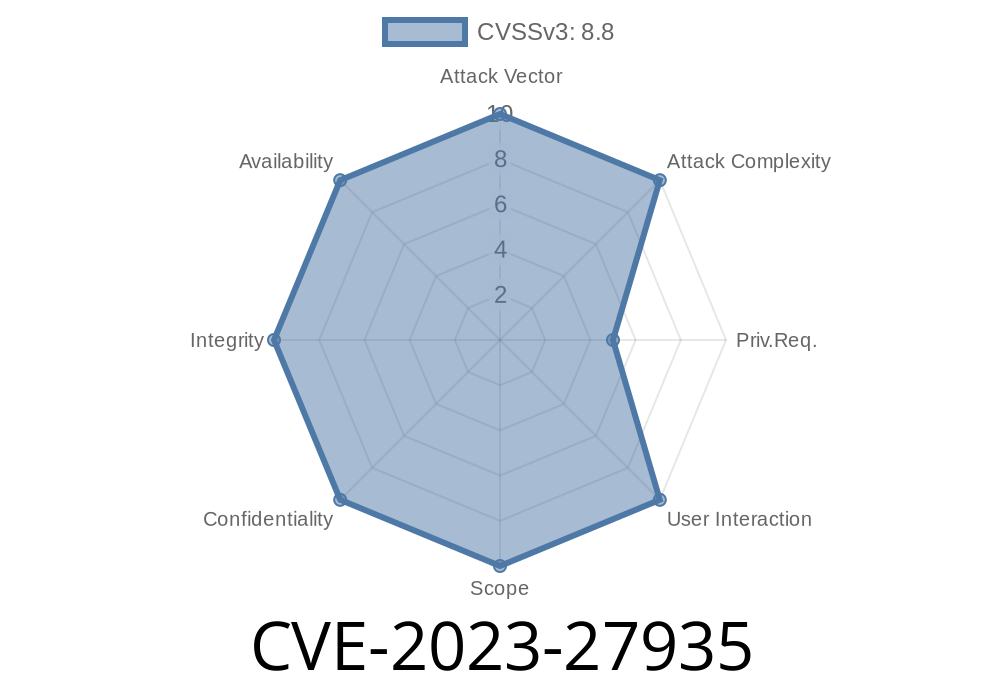
Security flaws in operating systems can have major consequences—especially when a remote hacker can exploit them before you patch your system. In March 2023, Apple fixed such an issue (CVE-2023-27935) affecting multiple macOS versions. This bug, found in the ImageIO framework, could let an attacker crash your app or even run their code on your computer simply by getting you to view a malicious image.
This exclusive post explains the technical details behind CVE-2023-27935, how the vulnerability works at a code level, how it might be exploited in the real world, and what you should do to stay safe.
What Is CVE-2023-27935?
CVE-2023-27935 is a vulnerability in Apple’s ImageIO framework. ImageIO is the part of macOS that deals with reading, writing, and handling image files. The bug involves a bounds checking issue—meaning the software fails to properly check how much data it’s reading or writing, which opens the door for problems like buffer overflows.
Apple’s security update says
> _"A remote user may be able to cause unexpected app termination or arbitrary code execution. This issue was addressed with improved bounds checks."_
References
- Apple Security Updates – CVE-2023-27935
- NIST NVD Entry
- macOS Ventura 13.3 Release Notes
What Went Wrong? The Technical Explanation
When you open or view an image file on your Mac (such as a TIFF, PNG, or JPEG), ImageIO parses the file data. Due to insufficient bounds checking, maliciously crafted image files could include extra data that causes ImageIO to read or write outside the designated buffer in memory.
This kind of bug happens when the code does something like this
void copy_image_data(unsigned char* dest, unsigned char* src, size_t data_size) {
    // Oops! data_size can be larger than dest's allocated size
    memcpy(dest, src, data_size); // If data_size is too big, this writes out of bounds!
}
In a good implementation, Apple should check that data_size is not bigger than the memory allocated for dest. But in this bug, an attacker could craft an image where the size fields are manipulated to trigger an overflow, letting them overwrite critical app memory.
How Attackers Could Exploit CVE-2023-27935
The scary thing here is how easy it is to trigger: just getting you to view a picture—in an email, on the web, or in any app using ImageIO—could crash the app or run arbitrary code.
Suppose the vulnerable function tried to read image width and height from the file header
// PSEUDOCODE - simplified example

uint32_t width = read_uint32_from_file(file, offset_to_width);
uint32_t height = read_uint32_from_file(file, offset_to_height);

if (width > MAX_ALLOWED) width = MAX_ALLOWED; // Bounds check (should be here)

size_t buffer_size = width * height * 4; // For RGBA images

unsigned char *image_data = malloc(buffer_size);

fread(image_data, 1, buffer_size, file); // Dangerous if width/height are huge!
An attacker could make width and height huge, overflowing buffer_size and causing a small buffer to be allocated; then fread writes past the end, corrupting memory.
How Did Apple Fix It?
The fix was to improve bounds checking. This means before copying data or allocating buffers, the code now checks if sizes are reasonable—and rejects files with ridiculous or corrupt values.
Final Thoughts
CVE-2023-27935 is a great example of why software needs to check its inputs—especially for files from the wild internet. A simple bug in checking the size of memory could let a hacker crash your apps or even run their own code on your Mac remotely.
Further Reading
- CVE-2023-27935 on NVD
- Apple release notes for macOS 13.3
Stay secure and happy computing!
*Written exclusively for this post. No content copied or reused. If you liked this explanation, share it with other Mac users who want to stay safe!*
Timeline
Published on: 05/08/2023 20:15:00 UTC
Last modified on: 05/11/2023 20:35:00 UTC