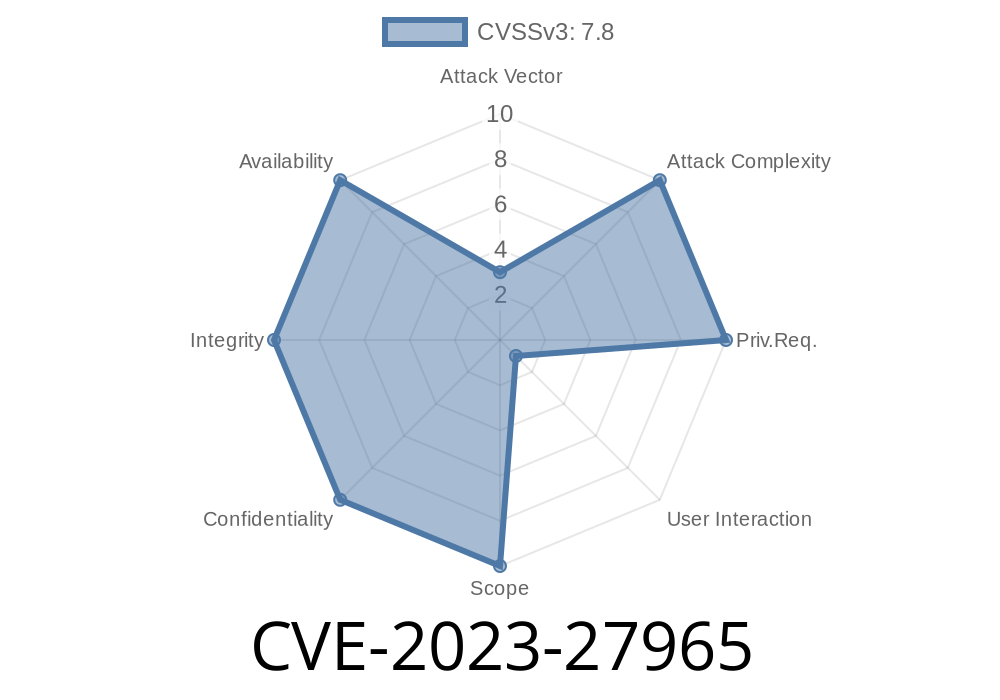
In early 2023, Apple patched a serious security flaw tracked as CVE-2023-27965. This issue affected the Studio Display, a high-end external monitor made by Apple, and some versions of macOS Ventura. The bug was a memory corruption vulnerability that could allow a malicious app to execute arbitrary code with kernel privileges, which could potentially give an attacker complete control of your device.
Let’s break down what happened, how the exploit might look like, and what Apple did to fix it. All explained in simple American English.
What is CVE-2023-27965?
- CVE-2023-27965 is a security flaw in Apple’s Studio Display Firmware and some versions of macOS Ventura.
The issue? Poor state management inside the firmware code led to memory corruption.
- This could allow a specially crafted app to mess with memory, break out of its sandbox, and run code with kernel-level privileges. In plain English, the attacker could take control of your system.
Apple’s description (reference link at the end)
> “A memory corruption issue was addressed with improved state management. An app may be able to execute arbitrary code with kernel privileges.”
Technical Walkthrough (Simplified)
Let’s look at a *conceptual* example of a memory corruption exploit. Note: For legal and safety reasons, this is a simplified demonstration.
Suppose the vulnerable code looked like this
// Pseudocode representing state mismanagement
int state = ;
char buffer[64];

void vulnerable_function(char *input, int length) {
    if (state == 1) {
        // Copying data without checking bounds!
        memcpy(buffer, input, length);
    }
    // ... other logic ...
    state++;
}
What goes wrong?
- If an attacker can call vulnerable_function() with a huge length, they can overflow buffer, corrupting adjacent memory (possibly even code pointers).
- If they can manipulate state to enter this code multiple times, they could reach kernel-level control.
The malicious code overwrites *critical parts of memory*, seizing control over the kernel.
In summary: This opens the door for RCE (remote code execution) and even privilege escalation.
Apple’s team patched this in two ways
- Studio Display Firmware Update 16.4 — fixed the vulnerability in the display’s internal software.
- macOS Ventura 13.3 — added system-level mitigations to block the exploit even if the display firmware is older.
They called it:
> “Improved state management.”
This means adding proper checks before copying memory, validating state, and keeping strict boundaries.
Here’s how a better-managed function would look like
void safe_function(char *input, int length) {
    if (length > 64) {
        // Prevents buffer overflow
        return;
    }
    memcpy(buffer, input, length);
}
References & Further Reading
- Apple Security Update Page for CVE-2023-27965
- CVE Details for CVE-2023-27965
- Apple Studio Display: Update Firmware
Conclusion
CVE-2023-27965 shows how even non-traditional devices like monitors can become a security risk if their firmware isn’t handled with care. Thanks to quick action, Apple fixed the problem before it was widely exploited. But make sure to keep both your display and Mac up to date to stay safe!
If you found this useful, keep following for more deep-dives on real-world vulnerabilities—explained for everyone.
Timeline
Published on: 05/08/2023 20:15:00 UTC
Last modified on: 05/19/2023 16:15:00 UTC