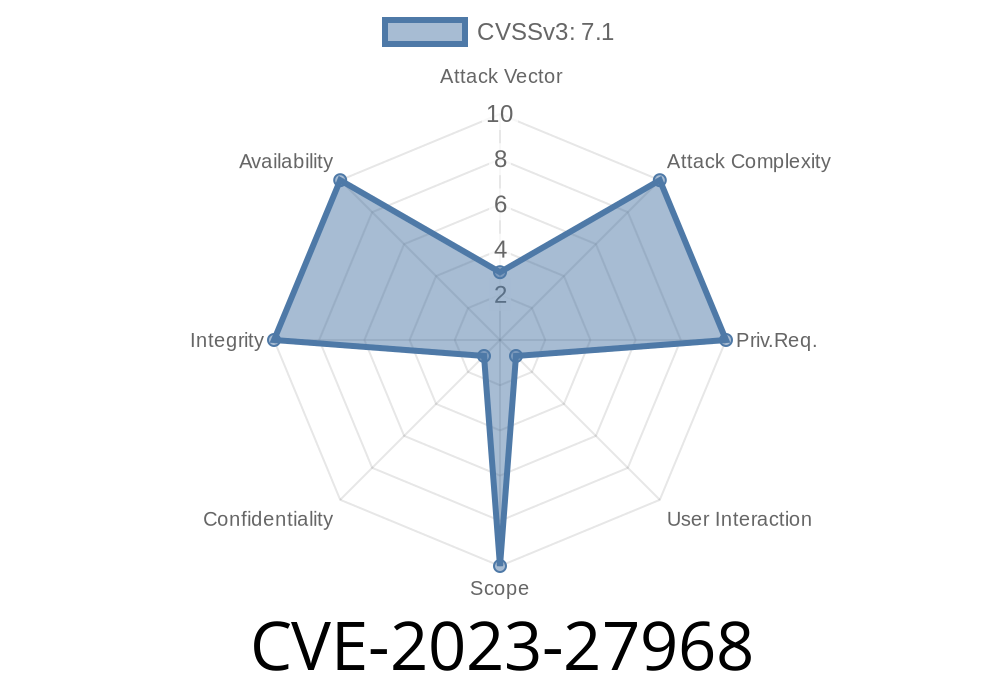
When it comes to security, even the world’s most popular operating systems can have severe bugs hidden in plain sight. This long read explores CVE-2023-27968—a buffer overflow in Apple’s macOS, patched in Ventura 13.3. We’ll break the vulnerability down, show a code snippet illustrating the issue, provide links to Apple's security update, and discuss how attackers could exploit this flaw.
What Is CVE-2023-27968?
CVE-2023-27968 is a buffer overflow vulnerability that affected macOS before version Ventura 13.3. In simple terms, a buffer overflow happens when more data is written to a memory buffer than it can hold, causing the system to overwrite adjacent memory. If an attacker can control what’s written, this could mean crashing the Mac (“unexpected system termination”) or, much worse, gaining the ability to make changes or execute code in protected parts of memory (“write kernel memory”).
Apple’s advisory puts it directly
> “A buffer overflow issue was addressed with improved memory handling. This issue is fixed in macOS Ventura 13.3. An app may be able to cause unexpected system termination or write kernel memory.”
>
> — Apple Security Updates, March 27, 2023
Technical Details, Made Simple
A buffer is like a row of boxes (memory slots) that a program fills. If a program isn’t careful, it might put 12 items in a row of 10 boxes. The extra items spill over into someone else’s boxes, changing things they shouldn’t.
In vulnerable versions of macOS, a part of the system’s code accepted data from apps without properly checking its size. If a rogue app sent too much data, it could “overflow” the buffer, overwriting parts of the system’s memory—including, potentially, critical kernel data.
Buffer Overflow Code Example (C Style)
Here is a generic C code snippet to help you understand what such an error might look like in practice:
#include <stdio.h>
#include <string.h>

void vulnerable_function(const char *input) {
    char buffer[16];
    // Dangerous: No length check
    strcpy(buffer, input);
    printf("You entered: %s\n", buffer);
}

int main(int argc, char *argv[]) {
    if (argc > 1) {
        vulnerable_function(argv[1]);
    } else {
        printf("Usage: %s <input>\n", argv[]);
    }
    return ;
}
In the example above, strcpy puts everything from input into buffer, even if it doesn’t fit. If an attacker provides a long input (say, 100 bytes), it will overrun the buffer and start overwriting neighboring memory, potentially hijacking the flow of execution.
While Apple doesn’t reveal the exact module affected, most system-level buffer overflow issues boil down to this type of memory handling bug.
System Crash or Code Execution
Overwritten kernel memory can make the system unstable (crash), or—if the input is very carefully crafted—let the attacker hijack kernel-level processes and potentially execute arbitrary code with system privileges.
Example Exploit (Proof of Concept)
Suppose you know the vulnerable function accepts a string. An attacker would give it an input much longer than expected, for example:
# Suppose the vulnerable code is run as:
./vulnerable_app AAAAAAAAAAAAAAAAAAAAAAAAAAAAAAAAAAAAAAAAAAAAAAAAAAAAAAA
If the buffer is only 16 bytes, but the input is 64 bytes, the extra “A”s overwrite memory past the end of the buffer.
Real kernel exploits are much more complicated, since modern macOS includes protections like Address Space Layout Randomization (ASLR) and Stack Canaries—but the basic principle remains the same.
Real-World Impact
Before the fix, this bug could let a buggy or malicious app crash the system, or (worse) perform kernel memory writes. Kernel memory is the heart of any operating system—if compromised, attackers could take control of the entire machine, install rootkits, or access sensitive data.
Apple credits “an anonymous researcher” for the discovery, which suggests this flaw was not widely exploited before it was patched.
How Was It Fixed?
Apple’s patch “improved memory handling”—this likely means size checks were added to make sure buffers can’t be overrun:
strncpy(buffer, input, sizeof(buffer) - 1);
Or, better, careful validation of input size before copying.
Apple Security Update (March 27, 2023):
https://support.apple.com/en-us/HT213670
NVD Entry:
https://nvd.nist.gov/vuln/detail/CVE-2023-27968
MITRE’s CVE page:
https://cve.mitre.org/cgi-bin/cvename.cgi?name=CVE-2023-27968
General info on buffer overflows:
What Should You Do?
If you’re running macOS:
Make sure you’ve updated to at least Ventura 13.3 or later—older versions are vulnerable!
Developers:
Use safe memory functions when working with buffers
Security Researchers:
Final Thoughts
CVE-2023-27968 is a textbook example of how even giant tech companies can get caught by classic bugs. The lesson is clear: always check your boundaries, update your system promptly, and keep learning. With macOS Ventura 13.3 and beyond, Apple once again shows the importance of proactive patching.
Timeline
Published on: 05/08/2023 20:15:00 UTC
Last modified on: 05/12/2023 19:47:00 UTC