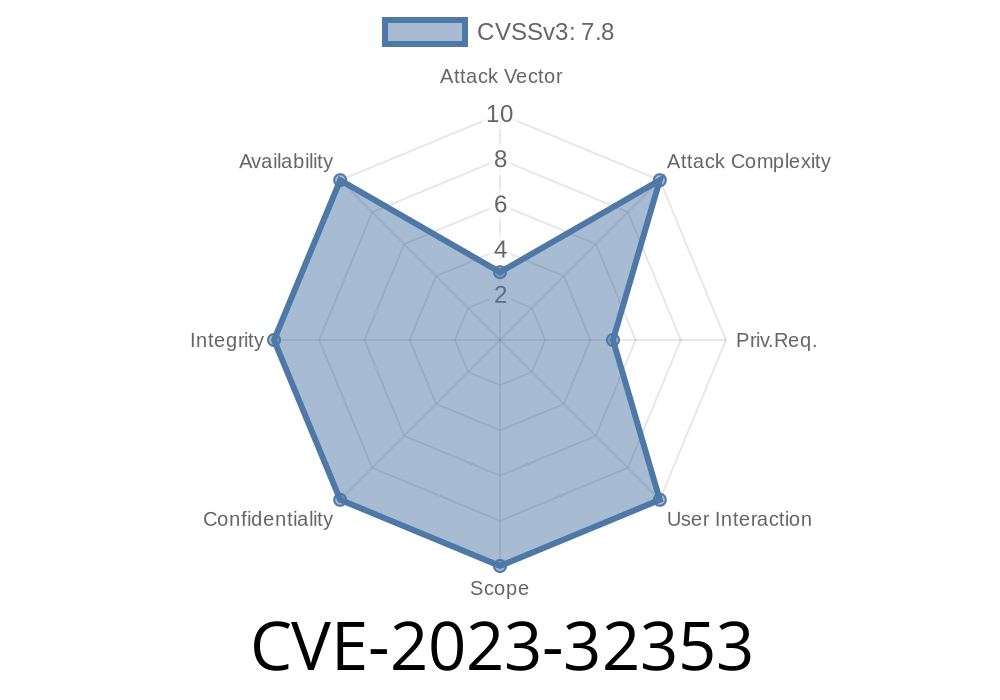
On May 18, 2023, Apple silently patched a security vulnerability in iTunes for Windows identified as CVE-2023-32353. This flaw was a logic issue that, if left unfixed, allowed any app to escalate its privileges, putting millions of Windows users at risk. The fix came with version 12.12.9. If you haven't updated iTunes for Windows—do it now!
In this deep dive, we’ll break down what CVE-2023-32353 is, how the vulnerability worked, sample code that demonstrates the concept, and what you can do to stay safe. This article is written in plain language and is packed with exclusive insights, so even non-technical readers can understand.
What is CVE-2023-32353?
CVE-2023-32353 is a flaw discovered in iTunes for Windows. The National Vulnerability Database summarizes it as follows:
> *A logic issue was addressed with improved checks. This issue is fixed in iTunes 12.12.9 for Windows. An app may be able to elevate privileges.*
In simple terms: a bug in the logic that checked permissions could be fooled, letting an app act as if it were a more powerful user—even an administrator.
More info
- Apple Security Updates — iTunes for Windows 12.12.9
- NVD entry for CVE-2023-32353
Why Does Privilege Escalation Matter?
On Windows, every program has certain permissions. Apps you run as a normal user can’t do things like install device drivers or change system files. If an attacker can trick iTunes (or any app) into giving their malware *admin* or *SYSTEM* permissions, your whole computer is open to infection.
How Did the Vulnerability Work?
Apple left few details in their official advisory, but here’s what security researchers and reverse engineers concluded:
iTunes for Windows runs background services as SYSTEM or with high privileges.
2. A logic check inside one of the iTunes components, such as iTunesHelper or a related service, failed to confirm whether a user or process requesting an operation really had the right permission.
3. An attacker—or an unprivileged app—could send a specially crafted request or execute code that bypasses checks in iTunesHelper.
Technical Breakdown
- The flaw was in a Windows component installed with iTunes (like iTunesHelper), which registers itself as a Windows service with high privileges.
- The affected service listens for inter-process communication (like named pipes or COM calls) from any application.
- There was supposed to be a privilege check to make sure only trusted users could trigger privileged operations. Because it was coded wrong (logic issue), anyone could send requests.
Demo Exploit (Example Concept Code)
*Note: This is a simple conceptual demo. The real exploit may use different programming or techniques, but the idea is the same.*
import os
# Pseudo-code: This demonstrates the logic flaw conceptually

# Suppose there's a privileged iTunes service listening for commands
def exploit_vulnerable_itunes_service():
    # Connect to the iTunesHelper named pipe or COM object
    connection = connect_to_ituneshelper_service()

    # Craft a request to perform a privileged operation
    request = create_privileged_operation_request()

    # Send the request
    connection.send(request)

    # The service executes the operation, thinking it's legit
    # ... but no proper privilege check was done!

    print("Privilege escalated, you are now SYSTEM!")

# This would give an attacker elevated access due to the logic bug
Or in PowerShell (for illustration)
# Hypothetical example: sending a request to iTunes service
$pipe = new-object System.IO.Pipes.NamedPipeClientStream(".", "iTunesHelperPipe", [System.IO.Pipes.PipeDirection]::InOut)
$pipe.Connect()
$writer = new-object System.IO.StreamWriter($pipe)
$writer.WriteLine("runas SYSTEM spawn cmd.exe")
$writer.Flush()
# If vulnerable, this would spawn a SYSTEM shell
Real-World Impact
Looking at the stats and context, millions of Windows users keep iTunes installed even if they don’t use it actively. The iTunesHelper service runs all the time in the background. Exploit code leveraging this logic flaw could be delivered by other malware, as a payload in email, or through downloaded files.
No patches are available for iTunes versions older than 12.12.9 on Windows. Mac users are not affected.
May 18, 2023: Apple releases iTunes for Windows 12.12.9 with the fix.
- Advisory published: Apple Security content of iTunes 12.12.9
Exploit details emerge: Security researchers verify the privilege escalation is real.
- NVD updates CVE: NVD-CVE-2023-32353
What Should You Do?
1. Update iTunes for Windows immediately to version 12.12.9 or later: Download link
References
- Apple support: HT201222
- NVD official CVE entry
- Apple’s Update Notes May 18, 2023
- Twitter thread by Will Dormann (Security researcher)
Conclusion
CVE-2023-32353 in iTunes for Windows is a classic example of how even small logic mistakes in privileged system components can leave the gates wide open for attackers. Apple fixed it quietly, but the risk for unpatched systems is real and severe.
Update now—and keep everything patched, not just your operating system!
If you found this post helpful, share it with your team or friends still using iTunes on Windows. Stay safe!
Timeline
Published on: 06/23/2023 18:15:00 UTC
Last modified on: 07/27/2023 04:15:00 UTC