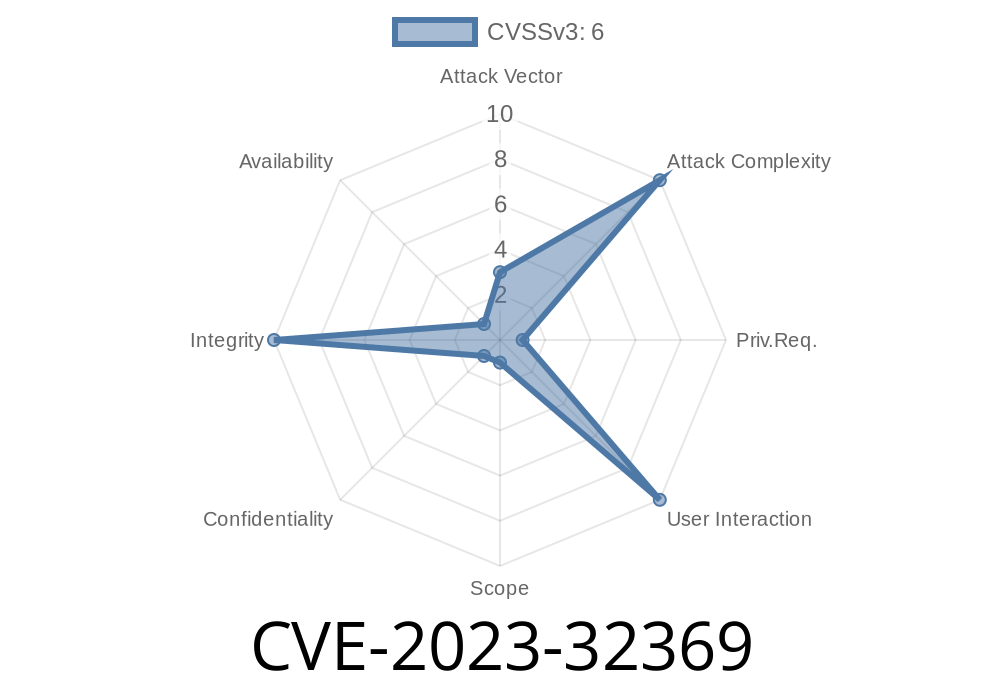
In May 2023, Apple released important security updates addressing several vulnerabilities across its operating systems. One of the most critical bugs fixed was CVE-2023-32369, which could allow an application to modify protected parts of the macOS file system—a serious security risk. Let’s dive into what happened, what this means for users, and how attackers could have exploited it, all explained in everyday language.
What is CVE-2023-32369?
CVE-2023-32369 is a logic issue in how macOS handled state management for file system protections. This bug created an opening where a rogue or malicious application could bypass normal security checks and change files in areas of the operating system that should be forbidden, even from apps with elevated privileges.
Apple’s own advisory describes it as
> “A logic issue was addressed with improved state management. This issue is fixed in macOS Ventura 13.4, macOS Big Sur 11.7.7, and macOS Monterey 12.6.6. An app may be able to modify protected parts of the file system.”
> — Apple Security Release Notes
Why Is This Dangerous?
macOS has strict controls over which files an app can touch, using features like System Integrity Protection (SIP) and File System Permissions. The purpose is to make sure *no app*—even those you install yourself—can sneak around and change things like system binaries or key configuration files.
This vulnerability undercut that security, possibly giving an app the keys to the kingdom. An attacker with this power could:
How the Exploit Might Work
While Apple did not release a public proof-of-concept, we can infer from the type of bug—a *logic flaw in state management*—what might have gone wrong.
For example, suppose the macOS logic for granting file access to an app didn’t properly check whether previous authentication by the user (or in certain update scenarios) should still be honored. A malicious app could:
Abuse temporary admin permissions.
2. Manipulate existing temp files or mount points created during upgrades or updates, tricking the system into thinking it’s allowed to write outside its sandbox.
Bypass SIP-protected directories using API calls that weren't adequately protected.
Here’s a hypothetical (and simplified) code snippet showing what a malicious developer might attempt:
// Objective-C: Attempting to write in a SIP-protected directory

NSString *protectedPath = @"/System/Library/SomeProtectedDirectory/malicious.dylib";
NSString *maliciousContent = @"evilcode";

NSError *error = nil;
BOOL success = [maliciousContent writeToFile:protectedPath
                                   atomically:YES
                                     encoding:NSUTF8StringEncoding
                                        error:&error];

if (success) {
    NSLog(@"Exploit successful! Modified protected file system.");
} else {
    NSLog(@"Exploit failed: %@", error);
}
Under normal circumstances, this code would fail. But with the logic flaw, attackers could sneak their files into protected places.
macOS Big Sur versions *before* 11.7.7
If you haven’t updated since May 2023, you’re at risk.
How Do I Stay Safe?
- Update your macOS. Go to System Preferences > Software Update and get at least the version listed above.
More Technical Details
Apple is tight-lipped about full details (to protect users), but clues from security researchers and the type of issue suggest the flaw was in the way temporary state from prior elevated operations was not properly reset or checked. For instance, after updating or installing certain packages, the system may have left open a “window” where access control lists (ACLs) were ineffective or pointers were still valid.
Here’s a simplified way to visualize the bug
// Pseudocode for state mismanagement

if (user_did_reboot_after_update == false) {
    grant_access = true; // Grant file system access
}
// But the condition doesn't check all paths or gets triggered at the wrong time
References & Further Reading
- Apple Security Updates May 2023
- NVD CVE-2023-32369 Entry
- Eclectic Security Analysis
- What is System Integrity Protection?
Conclusion
CVE-2023-32369 is a prime example of why keeping your operating system fully updated is critical. Even with macOS’ robust security, logic bugs can open dangerous holes, letting malicious apps do things they should never be allowed to do. Apple’s fix closed that hole, but the best defense is always a proactive update regime.
If you’re running a Mac, update today!
*This post is intended for educational and awareness purposes only. Attempting to exploit this or other vulnerabilities without permission is illegal and unethical.*
Timeline
Published on: 06/23/2023 18:15:00 UTC
Last modified on: 06/23/2023 20:21:00 UTC