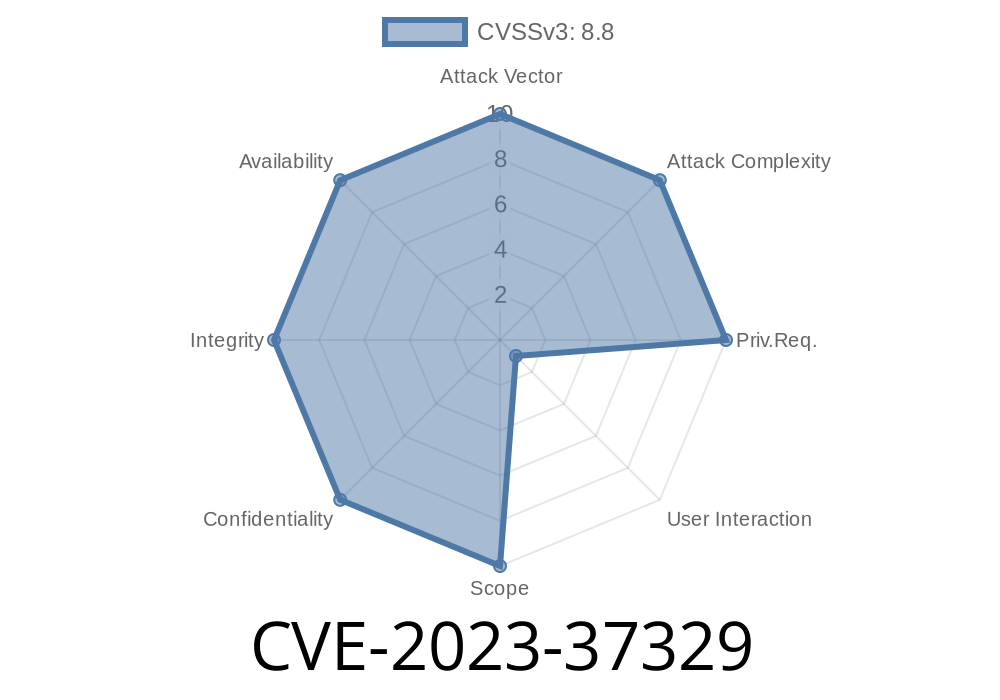
GStreamer is a widely-used open source multimedia framework found in popular desktop environments, media players, browsers, and even embedded systems. In June 2023, a critical vulnerability—CVE-2023-37329—was reported in GStreamer's handling of SRT subtitle files. This flaw, found and responsibly disclosed as *ZDI-CAN-20968*, is a heap-based buffer overflow that can lead to remote code execution (RCE). In this long read, I’ll walk you through the vulnerability, its causes, potential exploitation, and mitigation—using clear language for developers, sysadmins, and curious learners.
Component: GStreamer (libgstsrtp, SRT file parser)
- Exploitability: Remote (requires the target to process/click/open/share a malicious SRT subtitle file)
- Impact: Attackers can execute arbitrary code within the permissions of the application processing the SRT file.
CVE Description:
A heap-based buffer overflow vulnerability exists when GStreamer parses SRT subtitle files and fails to validate the length of user-supplied data before copying it into a memory buffer. By tricking a victim (for instance, via malicious video files with accompanying SRT subtitles), attackers could gain control of the target system.
Why SRT Files?
The SRT (SubRip Subtitle) format is extremely common—think .srt files with your videos. Attackers routinely target subtitle parsers, since malware delivered this way can bypass firewalls, anti-virus, etc., and often gets processed with high privileges.
Vulnerability Details: Digging Into the Bug
The issue lies in how GStreamer's SRT parser reads, parses, and copies subtitle content. Specifically, input from a given SRT file is not properly checked for length before being written into a buffer on the heap.
It parses the line assuming some maximum length.
- The code copies the line data directly into a heap-allocated buffer without confirming the SRT file actually respects the maximum expected size.
Below is a pseudo-code example representing the risky pattern
#define MAX_LINE_LENGTH 256

char *buffer = malloc(MAX_LINE_LENGTH);

// Attacker-crafted line much longer than MAX_LINE_LENGTH
fgets(input_line, sizeof(input_line), srt_file);

strcpy(buffer, input_line); // No length validation! Boom: Overflow!
If input_line comes from a large user-controlled SRT file, strcpy will keep copying until it hits a null byte, overflowing past buffer into adjacent heap memory, corrupting it and allowing attacker-controlled execution.
In real GStreamer code, the SRT subtitle parser processes lines from the file, but doesn't ensure the sources are safely bounded.
To exploit this vulnerability
1. Craft a malicious SRT file with a very long subtitle line or malformed payload that, when parsed, causes the buffer to overflow.
Via shared network drives
3. Victim opens or processes the media file. When GStreamer parses the SRT, it overruns the buffer and overwrites control structures (such as return addresses or function pointers).
4. Arbitrary code execution happens—attackers can run malware in the context of the media player or application.
Proof-of-Concept SRT Snippet
1
00:00:01,000 --> 00:00:02,000
... [repeat A's to several KBs]
Even a simple overlong line like this can cause a crash. With additional work, an attacker could overwrite heap metadata to gain code execution.
References
- ZDI Advisory ZDI-23-869 (ZDI-CAN-20968)
- NVD - CVE-2023-37329 Record
- GStreamer Official Website
- What is a Heap Overflow? — OWASP
Upgrade GStreamer
- Check your Linux distribution, Mac, or Windows package manager for updated GStreamer packages that patch CVE-2023-37329.
- The fix involves proper length checking and use of safe functions (strncpy, buffer size checks, etc.)
Conclusion: Think Before You Subtitle
CVE-2023-37329 is an example of how even the most popular and widely-trusted multimedia libraries can harbor critical remote code execution flaws in little-inspected corners—like subtitle file parsing. Never assume that simple text-based inputs (like SRT files) are harmless! Always patch and use software responsibly.
Stay secure—and review your multimedia pipelines for old, unpatched libraries.
For more in-depth technical write-ups, check Zero Day Initiative or GStreamer’s security advisories.
Timeline
Published on: 05/03/2024 02:15:43 UTC
Last modified on: 06/04/2024 17:24:32 UTC