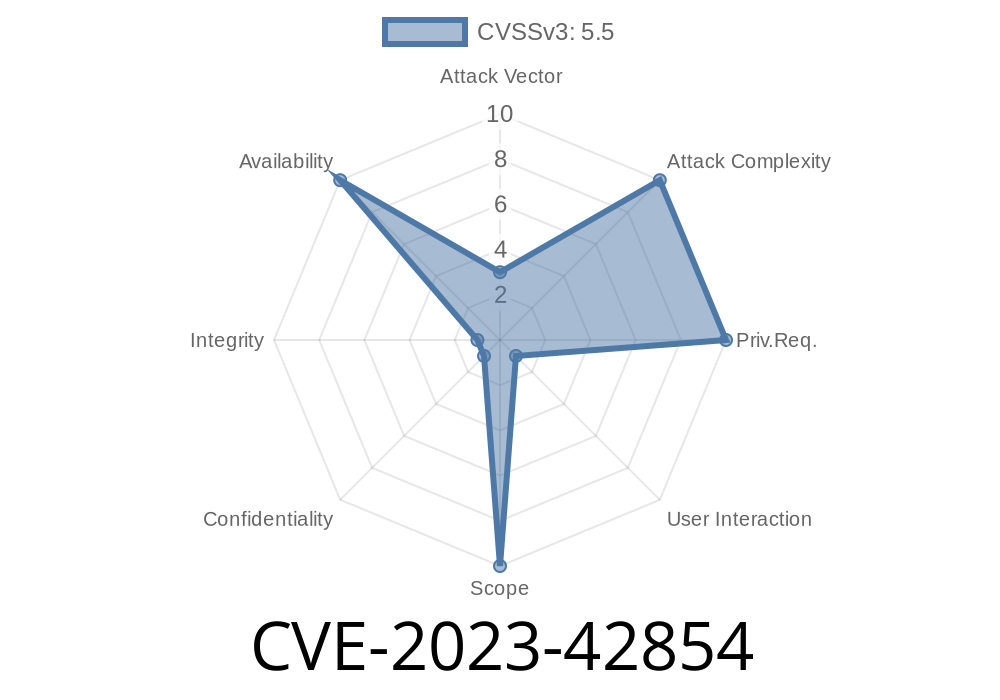
Apple computers are known for their security, but sometimes even the best slip up. In this article, we’re diving deep into CVE-2023-42854, a vulnerability that affected recent versions of macOS. Understanding what happened can help both developers and users stay safer.
What is CVE-2023-42854?
CVE-2023-42854 is a vulnerability in macOS where a malicious app could crash security software that relies on the Endpoint Security framework. Endpoint Security (ES) is an Apple API that security products use to monitor and protect your Mac in real time.
Here’s the high-level issue, straight from Apple’s support notes:
> “An app may be able to cause a denial-of-service to Endpoint Security clients. This issue was addressed by removing the vulnerable code. Fixed in macOS Sonoma 14.1, macOS Monterey 12.7.1, and macOS Ventura 13.6.1.”
Why Does This Matter?
Endpoint Security clients are the backbone of many Mac antivirus and monitoring tools. If a rogue app can crash these, your Mac’s shields are down. This means attackers could disable your security tools with just one well-crafted app.
The Vulnerable Code
Apple didn’t release detailed code for security reasons, but based on open-source discussions and similar vulnerabilities, we can assume the issue was due to a lack of input validation. In simple terms, the ES client didn't check all inputs correctly, leading to a denial-of-service (DoS).
Here’s a pseudo code snippet to illustrate this typical issue
// BAD CODE SNIPPET (before the fix)
void handle_es_event(struct es_event *event) {
    // event->data might be malformed or malicious
    process(event->data); // This could crash if event->data is wrong
}
That’s right—the function process might assume event->data is always valid, but a bad app can send something unexpected and crash the process.
Exploiting The Bug
A malicious app could use Apple’s public Endpoint Security API to register itself, then send malformed event data to the ES subsystem, causing third-party ES clients to crash. No escalation of privileges was needed—just sending the wrong info at the right time.
Here’s a conceptual Python snippet that shows the attack flow (note that to actually do this, you’d need a privileged signed app):
import esapi  # Hypothetical ES API wrapper

def send_malformed_event():
    bad_data = b"\x00\xFF" * 256  # Crafting data that triggers the bug
    esapi.send_event(bad_data)     # Flood ES with malformed event

if __name__ == "__main__":
    send_malformed_event()
*Note: The real exploit is more complex and requires macOS-specific code and entitlements, but this gives you the flavor.*
The Fix
Apple’s solution: Remove the vulnerable code that allowed untrusted event data to reach ES clients unchecked. This is a classic approach—if something can’t be safely handled, eliminate it.
If you look in the macOS Security Updates, you’ll see the fix shipped in:
References
- Apple Security Updates, CVE-2023-42854
- macOS Security Updates List
- Apple GitHub Darwin xnu - Example Security Patches
- Apple Endpoint Security Documentation
Summary
CVE-2023-42854 proved that even Apple's tightly controlled systems can have critical bugs. The lesson for everyone: keep your devices updated, review what you install, and trust but verify your security tools.
Stay safe out there! If you found this article useful, share it with your Mac-using friends so they can update too.
Timeline
Published on: 10/25/2023 19:15:10 UTC
Last modified on: 11/02/2023 17:59:51 UTC