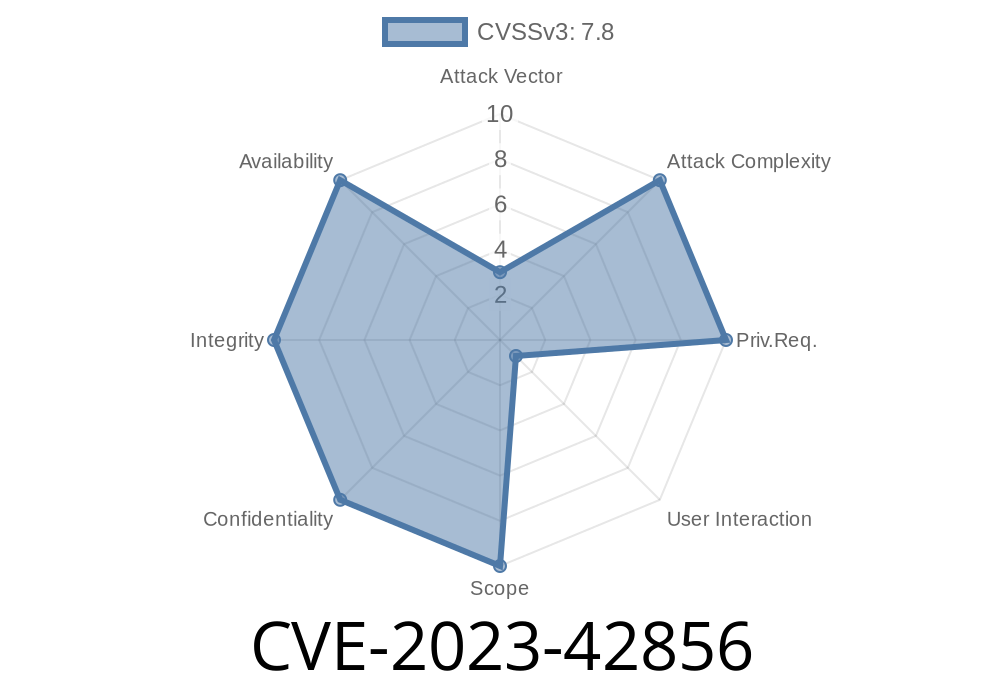
Security vulnerabilities are nothing new, but sometimes an issue pops up that affects a huge swath of devices and users. CVE-2023-42856 is one such flaw. This vulnerability was found in Apple’s ImageIO framework—a core component in macOS—and could let an attacker crash your apps or even run code on your system, just by getting you to process a malicious file.
In this exclusive deep dive, I’ll break down what CVE-2023-42856 is, how it works, and what you should do to stay safe. I’ll also share code snippets that help explain the exploit for techies, and link you to all the right resources.
What Is CVE-2023-42856?
CVE-2023-42856 is a memory handling issue in Apple’s ImageIO framework, which manages how macOS reads and writes image files used by everything from Photos to Preview to Mail. If a specially crafted image file is processed on a vulnerable system, it could lead to:
Apple patched this in the following updates
- macOS Sonoma 14.1
- macOS Ventura 13.6.1
- macOS Monterey 12.7.1
The Technical Details
The issue was caused by improper memory handling when processing image files (the official advisories don’t state which image file types are affected, but typically problems like this come with processing TIFF, JPEG, or even GIF files).
Example Exploit (Hypothetical)
While Apple does not provide public Proof-of-Concept code for recent vulnerabilities, we can show a theoretical example of how an exploit might abuse a memory handling flaw in image processing.
Suppose the vulnerability is in the way the size of a buffer is calculated for an image
// Vulnerable buffer allocation
uint32_t width = image->width;
uint32_t height = image->height;
uint32_t size = width * height * 4; // Assume 4 bytes per pixel (RGBA)

char *buffer = malloc(size); // No check for overflow!
fread(buffer, 1, size, fp); // Reads image data into buffer
If an attacker creates an image with a very large width and height, the multiplication could cause an integer overflow, leading to a much smaller buffer than expected, and fread would write too much data—smashing memory and potentially running attacker-controlled code.
App crashes (segfault)—annoying but not dangerous by itself
- Remote Code Execution—with the right payload, an attacker can gain control of your Mac via a boobytrapped image
Since many apps and the system itself use ImageIO, *you could trigger this just by previewing a file in Finder*.
How Was It Fixed?
Apple's fix: They improved memory handling in ImageIO, protecting against buffer overflows and related flaws by adding checks and validations before memory allocations, and by never letting untrusted image files create unsafe memory calculations.
Here’s a pseudo-code example of a safer approach
// Fixed: Check for integer overflow before allocating
uint32_t width = image->width;
uint32_t height = image->height;

if (width >  && height >  && width <= MAX_WIDTH && height <= MAX_HEIGHT) {
    size_t size;
    if (__builtin_mul_overflow(width, height, &size) || __builtin_mul_overflow(size, 4, &size)) {
        // handle error
    } else {
        char *buffer = malloc(size);
        if (buffer) {
            fread(buffer, 1, size, fp);
        }
    }
}
macOS Monterey 12.7.1
Go to Apple menu → System Settings → General → Software Update, and install the latest version. If you’re on an older macOS, check the Apple security updates page often.
References
- Apple Security Update for Sonoma 14.1
- Apple Security Update for Ventura 13.6.1
- Apple Security Update for Monterey 12.7.1
- CVE Detail: CVE-2023-42856
- Apple Security Updates
Final Thoughts
CVE-2023-42856 is a good reminder that even opening a simple image file can be dangerous if the software handling it isn’t careful. Apple’s quick patching shows they take these issues seriously, but it’s up to each user to keep their system updated.
Stay safe, and as always, *never open attachments from strangers—even if they look like harmless images*.
*If you’re interested in more security deep dives, follow this blog for future updates!*
Timeline
Published on: 10/25/2023 19:15:10 UTC
Last modified on: 11/02/2023 18:00:05 UTC