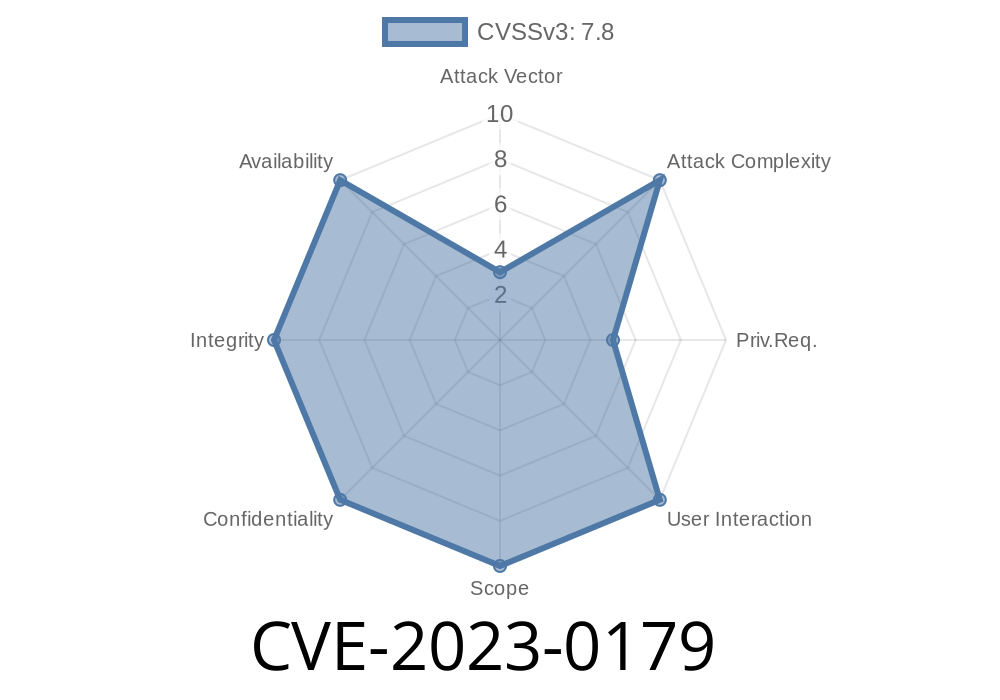
In early 2023, a significant security vulnerability known as CVE-2023-0179 was identified in the Netfilter subsystem of the Linux kernel. This vulnerability opens the door for local attackers to potentially leak sensitive memory addresses and, even worse, escalate their privileges to root by executing arbitrary code. In this post, I’ll break down what happened, show some of the critical code, and walk you through how this flaw can be exploited. Whether you’re a sysadmin, developer, or just a Linux enthusiast, understanding this bug can help you better secure your systems.
What is Netfilter?
Netfilter is a backbone part of the Linux kernel for handling network filtering, packet mangling, and NAT (Network Address Translation). If you've used iptables or nftables, you've worked with Netfilter.
The Vulnerability: CVE-2023-0179
Reference:
- Security Advisory
- Linux Kernel Commit
What went wrong?
A buffer overflow existed in the way Netfilter handles certain sets and objects, especially in the nft_set_elem_init() function in net/netfilter/nf_tables_core.c. This bug allowed writing more data into memory than it could safely handle. As a result, attackers could overwrite sensitive kernel structures and leak addresses from both the stack and the heap, overcoming modern hardening like KASLR (Kernel Address Space Layout Randomization).
Impact
The key problem: By exploiting this bug, a local attacker could gain root privileges.
In technical words, the problem led to Local Privilege Escalation (LPE) via arbitrary code execution in kernel space, all from user space.
Let’s look at a simplified version of the buggy code
int nft_set_elem_init(struct nft_ctx *ctx, const struct nft_set *set,
                      struct nft_set_elem *elem,
                      const struct nlattr *attr[], u64 flags)
{
    char buffer[64];  // Fixed size buffer

    // Vulnerable call: does not check length!
    memcpy(buffer, attr[NFT_SET_ELEM_ATTR_DATA], attr_len);

    // More processing ...
}
The issue:
The memcpy copies user-controlled data (attr[NFT_SET_ELEM_ATTR_DATA]) into a fixed-size stack buffer (buffer[64]) without checking if the data actually fits. If an attacker sends more than 64 bytes, they can overflow the buffer, overwriting adjacent kernel memory.
The Patch
The fix added a proper size check before copying data, stopping attackers from overflowing the buffer.
Overflow the buffer:
Send large payloads to overflow buffer[64] and smash adjacent stack variables, leaking stack canaries or function pointers.
Infoleak to bypass KASLR:
With carefully crafted payloads, attackers can read back memory containing addresses from the stack or heap, defeating kernel address space randomization.
Gain arbitrary code execution:
By manipulating control variables or function pointers, attacker gains execution of injected shellcode or ROP chain in kernel mode.
Escalate privileges:
Use code execution in kernel space to overwrite the current process credentials, setting UID and GID to (root).
Example Exploit Snippet
Here’s an *illustrative* example in Python using nftables netlink to trigger the overflow. (Do not run on production machines!)
import socket
import struct

# Create raw netlink socket (netfilter)
s = socket.socket(socket.AF_NETLINK, socket.SOCK_RAW, 10)  # NETLINK_NETFILTER=10

# Build malicious payload
payload = b'A' * 128  # Overflow buffer with 128 bytes, more than the buffer

# Normally, you'd use libmnl or similar, but this is illustrative
# Send a crafted message to 'nftables' subsystem
msg = struct.pack('<HHI', x10, len(payload), 1) + payload  # Type, len, flags

# Send it - this would reach the vulnerable code
s.send(msg)
*In real attacks, you would build a full netlink message structure and carefully craft the overflow data to control the kernel’s flow for privilege escalation.*
Real-World PoCs and Exploits
- Zdenda Haban’s PoC (Linux 5.10 Exploit)
- Exploit Details by Threatpost
Patch your kernel!
Upgrade to a kernel version newer than those listed here.
Conclusion
CVE-2023-0179 is a clear example of how small mistakes like unchecked data copying can lead to *massive* security vulnerabilities, even in one of the world's most widely used operating systems. If you manage Linux systems—especially ones that allow multi-user access—immediate upgrades and extra hardening are highly recommended.
References
- CVE Page: https://nvd.nist.gov/vuln/detail/CVE-2023-0179
- Commit & Patch: https://git.kernel.org/pub/scm/linux/kernel/git/torvalds/linux.git/commit/?id=24d1a6fa27c950d7ccb43e7a50562da5c7f3afe
- PoC code: https://github.com/xdenda/nft-bof
- Security write-up: https://threatpost.com/linux-kernel-privilege-escalation-bug/183507/
Timeline
Published on: 03/27/2023 22:15:00 UTC
Last modified on: 04/07/2023 12:42:00 UTC