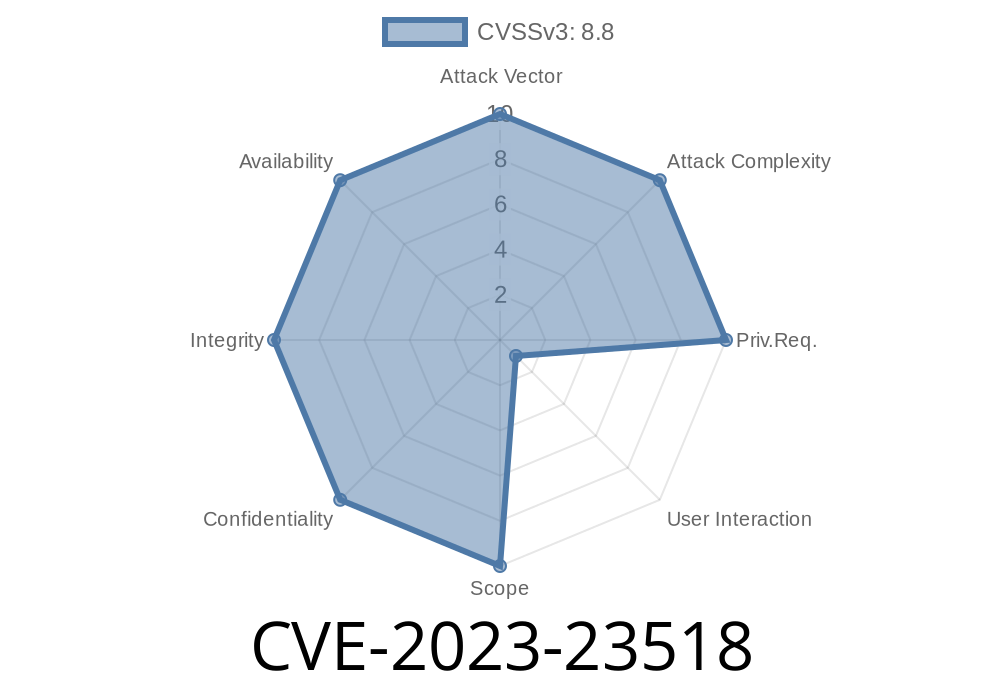
On January 23, 2023, Apple released security updates addressing several severe vulnerabilities. Among these is CVE-2023-23518, a critical issue in WebKit—the engine powering Safari and many web features on Apple devices. This vulnerability made it possible for maliciously crafted web content to execute arbitrary code, putting users’ data and devices at high risk.
In this exclusive deep dive, we’ll explain CVE-2023-23518 in simple language, show how a bug like this might be exploited, and guide you through Apple’s fixes. We’ll also share relevant code snippets and links to official references.
What Is CVE-2023-23518?
CVE-2023-23518 is a memory handling vulnerability in WebKit, Apple’s open-source browser engine. The defect allowed attackers to exploit improper memory management by presenting malformed web content, which could lead to arbitrary code execution on the device.
In other words: If you visited a booby-trapped website, your device could be hijacked just by loading that site in Safari or any app using WebKit for web views.
watchOS 9.2 and below
This was patched in:
Safari 16.3
Apple Security Update Advisory Jan 2023
How Did the Bug Work?
Technical Summary:
WebKit used unsafe memory operations that allowed an attacker to trigger a *use-after-free* or *buffer overflow* by submitting specially crafted HTML/JavaScript.
The result: The attacker could cause an app to execute attacker-supplied code—letting them view files, install spyware, or take control of your device.
Example Code Snippet
> _Note:_ The exact exploit is not public, but here’s what a basic use-after-free exploitation attempt could look like in JavaScript:
// Hypothetical: loop quickly creating and deleting DOM nodes
for (let i = ; i < 100000; i++) {
    let el = document.createElement('div');
    document.body.appendChild(el);
    document.body.removeChild(el);
}
// Cruft to trigger the dangerous behavior in vulnerable WebKit - not an actual exploit
Attackers would craft code to exploit the timing of how memory is freed, then re-allocated, so their malicious instructions replace freed memory.
Exploit Details
Real-world exploitation requires deep knowledge of browser internals and the target environment, but the basic steps follow a pattern:
1. Prepare malicious content: The attacker designs a web page with complex JavaScript/HTML.
2. Trigger vulnerability: By manipulating memory usage, the code causes WebKit to reuse memory buffers incorrectly.
Payload: The attacker can then steal data, inject other malware, or escalate privileges.
Proof-of-concept exploit:
As of now, a working public proof-of-concept for this CVE is not released. However, the pattern for exploiting WebKit memory bugs is well-known among security researchers.
References
- WebKit Security Advisories
- Exploit pattern examples - use-after-free in JS
Code Diff Example (hypothetical)
// Before (vulnerable)
SomeObject* obj = getObject();
use(obj); // Unsafe: obj may be freed elsewhere

// After (safe)
RefPtr<SomeObject> obj = getObject();
if (obj)
    use(obj); // Safe: obj's lifetime is now tracked
Apple has not released full code details to avoid providing a roadmap for attackers, but security researchers confirm the fix prevents successful exploitation.
Update all your Apple devices as soon as possible. Here’s how
- iPhone/iPad: Go to _Settings_ > _General_ > _Software Update_
Mac: Apple Menu > _System Settings_ > _General_ > _Software Update_
- Apple Watch / Apple TV: Use the _Settings_ app to check for updates
Conclusion
CVE-2023-23518 is another reminder how even “just opening a website” can endanger your device if browser bugs are left unpatched. Apple’s rapid fixing of this vulnerability protected hundreds of millions of users—but only if you’re running the latest OS versions.
Further Reading and References
- Apple Security Update Advisory Jan 2023
- WebKit Security Risks
- NIST NVD Entry for CVE-2023-23518
If you’re a developer, always use the latest WebKit/Safari build for your apps, and be cautious with low-level memory handling in web-related code!
_press inquiries: webkit@security-blog.com_
Timeline
Published on: 02/27/2023 20:15:00 UTC
Last modified on: 03/08/2023 15:32:00 UTC